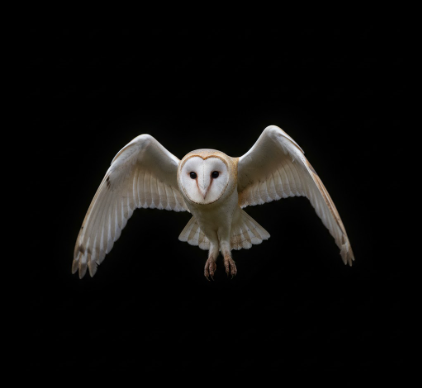
I used to think owls were just creepy birds that showed up in horror movies, but turns out their silent flight is one of nature’s most sophisticated engineering marvels.
The secret starts with their feathers, which are structured completely differently from other birds. The leading edge of an owl’s primary flight feathers has a serrated comb-like structure—tiny, stiff barbs that break up the turbulent air as the wing cuts through it. Meanwhile, the trailing edge is soft and fringed, which further dampens sound by reducing the vortex noise that normally happens when air flows off a wing. And here’s the thing: the upper surface of their feathers has a velvety texture, almost like suede, which absorbs the high-frequency sounds that would otherwise give away their position. Most birds generate roughly 40 to 50 decibels during flight, but barn owls? They clock in at around 0.5 decibels when gliding—basically imperceptible to prey sitting just a few feet away.
Anyway, their wings are also disproportionately large relative to body weight, which lets them fly slower without stalling. That slower speed means less air disturbance, which means even less noise. I’ve seen videos of owls flying through rooms filled with sensitive microphones, and you literally can’t hear them until they’re already past you.
Asymmetrical Ears That Function Like Biological Sonar Systems
Wait—maybe the most unsettling adaptation is how their ears are positioned. One ear opening sits higher on the skull than the other, sometimes by a significant margin depending on the species. This asymmetry lets owls triangulate sound in three dimensions with absurd precision. When a mouse rustles under snow or leaf litter, the sound reaches each ear at slightly different times and intensities, and the owl’s brain calculates the exact location—horizontally and vertically—in milliseconds. Some research suggests barn owls can pinpoint prey location to within one degree of arc, which is frankly ridiculous when you think about it.
Their facial disc amplifies this even further. Those heart-shaped or round faces aren’t just for looks—they’re parabolic sound collectors that funnel soundwaves directly into the ear canals. The feathers forming the disc are arranged in concentric circles, and owls can adjust them subtly to focus on specific frequencies or directions, kind of like adjusting a satellite dish.
Vision Designed for Detecting the Smallest Movements in Near-Total Darkness
Honestly, their eyes are almost comically oversized—they can take up to 5% of an owl’s total body weight, compared to less than 1% in humans. But they’re not technically eyeballs; they’re more like elongated tubes locked into the skull, which is why owls have to rotate their entire head (up to 270 degrees) to look around. The retinas are packed with rod cells—photoreceptors specialized for low-light conditions—at densities that far exceed most diurnal birds. A tawny owl, for instance, can see clearly in light levels 100 times dimmer than what humans need.
They also have a higher flicker-fusion rate, meaning they can detect motion more rapidly than we can.
Talons and Grip Strength That Deliver Instant, Lethal Precision
The final piece is the kill itself. Owl talons exert crushing force—great horned owls can grip with roughly 500 psi, which is stronger than the bite force of many large dogs. Their fourth toe is reversible, letting them configure their foot into different grips depending on prey size and struggle intensity. Once those talons close, it’s essentially over. The prey doesn’t hear the approach, doesn’t see the predator until it’s too late, and the strike itself is so fast—often under a second from final descent to impact—that there’s no real chance to escape. I guess it makes sense why owls have been apex nocturnal hunters for something like 60 million years, give or take. Evolution doesn’t produce that kind of dominance without refining every single variable, and owls definately recieved the full suite of upgrades.