I used to think okapis were just zebras that got lost in the wrong neighborhood.
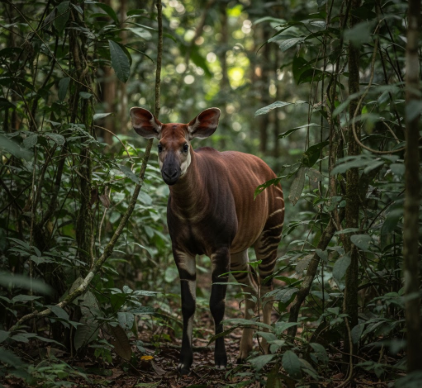
Turns out, these striped-legged creatures are actually the only living relatives of giraffes, and they’ve been hiding in the dense Ituri rainforest of the Democratic Republic of Congo for roughly 500,000 years, give or take. When British explorer Sir Harry Johnston first heard rumors of them in 1901, local Congolese people called them “atti,” and Europeans initially thought they were describing some kind of forest donkey. Wait—maybe that’s why it took so long for Western science to officially document them. The okapi’s reclusive nature meant that even indigenous Mbuti people, who’d lived alongside them for millennia, rarely encountered them. Their chocolate-brown bodies with zebralike hindquarters provided perfect camouflage in the dappled forest light, and their solitary habits meant you could walk past one and never know it was there. Johnston eventually sent a skin back to London, and zoologists were baffled—here was an animal that seemed stitched together from spare parts. The scientific name they settled on was Okapia johnstoni, because apparently we still name things after the Europeans who “discovered” them.
Here’s the thing: okapis are masters of invisibility not just because of their stripes, but because of how they’ve adapted their entire existence to avoiding detection.
The Acoustic Architecture of Staying Hidden in Central African Forests
Okapis communicate primarily through infrasound—frequencies below 14 Hz that humans can’t hear but that travel beautifully through dense vegetation. I’ve seen recordings of their vocalizations, and honestly, it’s eerie how silent they appear while apparently having entire conversations. Males mark territory with scent glands on their feet, leaving chemical messages without making a sound. Their large, rotating ears can detect predators—mainly leopards—from considerable distances, giving them time to melt into the undergrowth. The forest floor, thick with decomposing leaves, muffles their footsteps. They’re essentially ghosts with hooves.
Why Evolutionary Pressure Rewarded Reclusiveness and Camouflage Patterns
The okapi’s stripes aren’t decorative—they’re disruptive camouflage that breaks up their body outline in the fragmented light of the rainforest canopy. Young okapis are especially vulnerable to predation, so mothers hide their calves in dense vegetation for the first few weeks, visiting only to nurse. This behavior, combined with their naturally low population density (maybe one okapi per 2-3 square kilometers), means even dedicated researchers spend months without sightings. Genetic studies suggest okapis have been isolated in these forests since the Pleistocene, and that isolation has made them exceptionally well-suited to this specific environment. They’ve essentially optimized for not being found.
The Physiological Toolkit That Enables Forest Floor Navigation Without Detection
An okapi’s tongue is roughly 18 inches long and prehensile enough to clean its own eyes and ears—which sounds ridiculous until you realize it’s perfect for stripping leaves from branches without making the rustling sounds that would give away their position. They’re browsers, feeding on over 100 plant species, including some that are toxic to other animals. This dietary flexibility means they don’t have to range widely or compete aggressively for food, both of which would increase their visibility. Their metabolism is slow, their movements deliberate. Everything about them whispers rather than shouts.
How Human Encroachment and Political Instability Have Made Them Even More Elusive Paradoxically
Here’s where it gets complicated. The ongoing conflict in eastern DRC has made okapi habitat simultaneously more dangerous for the animals and more inaccessible to researchers. Illegal mining and logging have fragmented their range, but the region’s instability has also kept out the kind of large-scale agricultural development that has destroyed wildlife habitat elsewhere in Africa. Conservation groups estimate maybe 10,000-35,000 okapis remain—though honestly, nobody really knows because they’re so hard to count. Camera traps capture them occasionally, always looking startled, as if offended that anyone found them. I guess it makes sense that an animal evolved to be invisible would be terrible at adapting to a world where visibility equals protection through conservation attention. The okapi’s greatest survival strategy has become its biggest vulnerability, and that irony exhausts me.