I used to think naked mole rats were just wrinkly little potatoes with teeth.
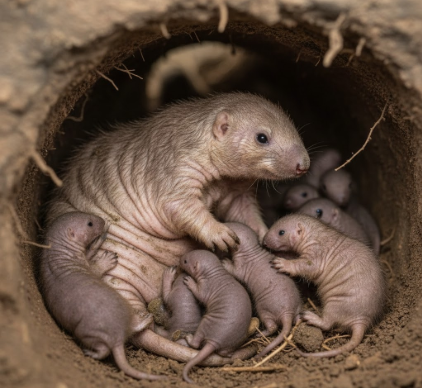
Then I learned about their queen, and everything got weird. These subterranean rodents—found mostly in the Horn of Africa, burrowing through Ethiopia, Kenya, Somalia—live in colonies that function more like beehives than mammal families. One female breeds. The rest don’t. It’s eusociality, the same reproductive setup you see in ants and bees, except this time it’s happening in a mammal with a backbone and a beating heart and all the biological equipment that should, theoretically, make every female capable of reproduction. But here’s the thing: only the queen actually does it. The workers, sometimes 300 strong in a single colony, spend their lives digging tunnels, hauling tubers, defending against snakes, and never—never—producing offspring of their own.
Turns out, it’s not just social pressure. The suppression is physiological, hormonal, deeply embedded in their biology. And it’s kind of brutal.
How One Female Ends Up Running the Entire Reproductive Show
The queen isn’t born into her role, exactly. She fights for it. When a colony loses its queen—through death, injury, whatever—the remaining females start scrapping. It’s vicious. They bite, shove, wrestle, sometimes for weeks. The winner doesn’t just get a crown; she gets a body that transforms. Her vertebrae literally lengthen, stretching her spine so she can accomodate larger litters. She starts producing more luteinizing hormone, which kicks her ovaries into overdrive. Meanwhile, the losers? Their reproductive systems stay dormant, suppressed by a cocktail of stress hormones and pheromones the queen pumps into the colony’s air. I guess it’s efficient, in a cold evolutionary sense. But it’s also kind of dystopian.
Scientists have measured this. When you remove a queen from her colony and isolate her workers, some of those workers start ovulating within weeks. Their bodies were ready the whole time—they were just being chemically held back.
Anyway, the queen’s dominance isn’t just about hormones. She’s physically aggressive, shoving subordinates around, nipping at them, asserting herself constantly. It’s like she’s reminding everyone, every single day, that she’s in charge. And the colony accepts it. The workers—mostly her offspring and siblings—feed her, groom her, and protect her. They’re complicit in their own reproductive suppression, which sounds insane until you remember they share roughly 80% of their genes with her. By helping her breed, they’re passing on their own genetic material, just indirectly. Kin selection at its finest.
Why Evolution Decided This Was a Good Idea for a Mammal
Here’s where it gets messy. Eusociality is rare. Like, really rare. It’s common in insects—ants, bees, termites—but in mammals? Just naked mole rats and their close relative, the Damaraland mole rat. That’s it. Two species out of roughly 6,400 mammal species on Earth. So why did it happen here?
The leading theory involves their environment, which is harsh, unpredictable, and unforgiving. Naked mole rats live in arid regions where food—mostly underground tubers—is scattered and hard to find. A single tuber might weigh 50 kilograms and feed a colony for months, but finding it requires digging hundreds of meters of tunnel through rock-hard soil. That’s exhausting, dangerous work. A solitary mole rat would struggle to survive. But a colony? A colony can pool labor, dig cooperatively, and defend resources together. The trade-off is that most individuals give up their own reproduction to support the group. Wait—maybe that’s not a trade-off at all. Maybe it’s the only way they could’ve survived in the first place.
And there’s another factor: inbreeding. Naked mole rat colonies are incredibly inbred, sometimes with genetic similarity approaching 90%. When everyone’s that closely related, the genetic cost of not reproducing yourself drops dramatically. You’re still propagating your genes through your siblings and nieces.
What Happens When the Queen Dies and Chaos Breaks Loose
I’ve seen footage of post-queen fights, and they’re unsettling. The colony fractures. Females who’ve spent years as docile workers suddenly turn aggressive, lunging at each other, drawing blood. It can take weeks for a new queen to emerge, and during that time, the colony barely functions. Tunnel maintenance stops. Foraging slows. It’s like the whole social structure collapses without that one dominant female holding it together.
Once a new queen is established, things stabilize. But the transition is violent, chaotic, and honestly kind of sad. The losers of those fights go back to being workers, their brief shot at reproduction over before it even began. Their bodies re-suppress. Their ovaries go quiet. And they return to the tunnels, hauling dirt and tubers for a sister or cousin who beat them in a fight.
The Uncomfortable Parallels Between Mole Rats and Other Social Animals
Researchers love comparing naked mole rats to bees, but I think the comparison that really stings is the one to humans. Not because we have queens—we don’t, obviously—but because we also live in complex social hierarchies where reproduction isn’t evenly distributed. We just do it more subtly, with economics and status and access to resources instead of pheromones and physical dominance. It’s uncomfortable to think about, but there it is.
Naked mole rats remind us that biology isn’t fair. Evolution doesn’t optimize for individual happiness or equality—it optimizes for gene propagation. And sometimes, the most effective strategy is to concentrate reproduction in one individual and turn everyone else into support staff. It works for them. They’ve been around for roughly 30 million years, give or take, thriving in environments that would kill most mammals. Their system is brutal, strange, and weirdly fascinating. I guess that’s why we can’t stop studying them.