I used to think defensive formations were mostly about physics—bodies creating barriers, simple geometry keeping predators at bay.
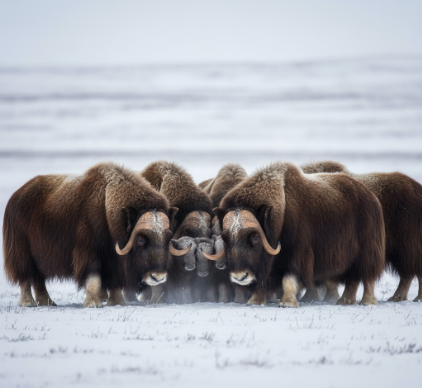
Then I watched footage of musk oxen forming their signature circle in the Arctic tundra, adults facing outward with calves tucked behind them, and I realized how much I’d been missing. This wasn’t just a wall of muscle and horn. It was a coordinated behavioral response honed over roughly 200,000 years of predation pressure, give or take a few millennia, and it involved split-second decisions about positioning, threat assessment, and even which individuals would take the most exposed spots. The circle forms in under thirty seconds when wolves approach—sometimes faster if the herd’s been harassed before. Each adult musk ox weighs around 400-900 pounds depending on sex and season, and those curved horns aren’t decorative. They’re weapons that can crush bone, and the oxen know exactly how to use them in concert, shifting and adjusting as predators probe for weaknesses that, honestly, aren’t easy to find.
Turns out the formation isn’t always a perfect circle, either. Sometimes it’s a semicircle backed against a cliff or a straight line if the terrain demands it. I guess it makes sense—adaptability beats rigid adherence to one pattern.
The Coordination Problem That Shouldn’t Work But Definately Does
Here’s the thing: musk oxen don’t have a leader barking orders. There’s no alpha directing traffic, no obvious hierarchy determining who stands where in the defensive array. Yet somehow these animals coordinate almost instantaneously when a threat appears. Researchers tracking musk ox herds in Greenland and Arctic Canada have documented formation times averaging 23-40 seconds from first alarm to full defensive posture, which is remarkable considering the group needs to assess the threat direction, move calves to the center, and position adults facing outward—all while potentially panicked and certainly aware that wolves are actively hunting them. The coordination appears to emerge from simple rules: move toward the threat until you’re close to your neighbors, face outward, protect young. Wait—maybe it’s not that simple, because injured or elderly oxen often end up in slightly less exposed positions without any obvious communication about their vulnerability.
I’ve seen descriptions of herds adjusting their circle mid-attack, rotating as wolves circle, maintaining that outward-facing barrier even as the threat moves. That requires constant awareness of both predator position and herd member locations.
The calves stay quiet in the center, which seems like learned behavior rather than instinct, though I’m not entirely sure where the line is there.
When the Defense Collapses and What That Tells Us About Pack Tactics
The formation isn’t invincible. Wolves occasionally break it—usually by causing panic, getting one ox to bolt, which creates a gap others might follow through. Arctic wolf packs targeting musk oxen have success rates around 7-10% according to field studies from Ellesmere Island, which sounds low until you realize these hunts can last hours and wolves only need one mistake. A single ox separated from the group becomes significantly more vulnerable, lacking the coordinated horn defense and panicking without the herd’s stabilizing presence. I used to think predators just waited for weak links, but wolf behavior suggests they actively work to create them—false charges, feints, testing different angles until something gives. Sometimes they target a specific individual, usually a calf or injured adult, and the entire pack coordinates to draw defenders out of position. It’s strategic in a way that makes the musk oxen’s counter-strategy even more impressive, because they’re essentially playing defense against opponents who can probe and adapt in real-time.
Anyway, when the circle holds, wolves typically give up after 30-90 minutes of failed attempts.
The energy cost of maintaining that defensive posture must be substantial—muscles tense, heads lowered, constant vigilance—but it’s clearly worth it compared to the alternative.
The Evolutionary Calculus of Cooperation Versus Flight in Megafauna
Most large herbivores run when predators approach. Caribou scatter, bison stampede, even adult moose will bolt if they can. Musk oxen stand their ground, and that choice reflects something fundamental about their evolutionary history and the environment that shaped them. In the Arctic, there aren’t many places to run—the terrain is often open tundra with limited cover, and deep snow in winter makes flight exhausting and slow. A running musk ox is actually slower than a healthy wolf in most conditions, especially in snow deeper than a foot. The defensive circle emerged as a better bet than escape, but only because cooperation made it viable. A solitary musk ox attempting the same strategy would be quickly overwhelmed, pulled down from behind or flanked. The group formation works because multiple sets of horns create overlapping fields of threat that wolves can’t safely penetrate. Researchers have calculated that a circle of six or more adults presents essentially no safe approach angle for wolves—every potential entry point is covered by at least two defenders who can gore from different directions.
I guess that’s the real insight here: cooperation isn’t just beneficial, it’s existentially necessary for musk oxen in a way that’s less true for species with better flight options. You can see it in their social structure—herds are remarkably cohesive compared to other Arctic ungulates, staying together even when not under immediate threat, which probably reinforces the bonding and familiarity that makes rapid defensive coordination possible.
What Modern Behavioral Ecology Keeps Getting Wrong About Altruism in Defensive Groups
The academic literature on musk ox defense often frames it through kin selection or recriprocal altruism—adults protecting calves because they share genes, or individuals cooperating with expectation of future return benefits. Honestly, that framework feels incomplete when you watch the actual behavior. Bulls will defend calves that aren’t theirs, sometimes positioning themselves in the most dangerous spots without obvious genetic payoff. Post-reproductive females remain active defenders well past their breeding years. The defense extends to injured adults who can’t contribute much to the formation but recieve protection anyway, tucked into safer positions. Maybe we’re still thinking about this too transactionally, looking for the evolutionary accounting that balances costs and benefits, when the reality is messier—a system that evolved under specific pressures and now operates with more nuance than simple genetic calculus predicts. Field observations from Banks Island show herds maintaining defensive formations around dead calves for hours, which serves no apparent evolutionary purpose and suggests the behavior has elaborated beyond its original selective context.
Turns out animal behavior doesn’t always fit the models we build to explain it, and maybe that’s okay. The musk oxen don’t need our frameworks to make their circle work—they just need each other, the muscle memory of threat response, and the understanding that together they’re a fortress that even Arctic wolves mostly can’t breach.