I used to think narwhals were some kind of medieval hoax, honestly.
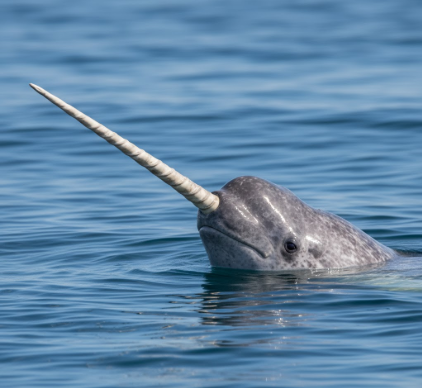
The first time I saw a photograph of one—this mottled gray whale with what looked like a spiral spear jutting from its head—I thought someone had Photoshopped a unicorn horn onto a dolphin for internet points. But here’s the thing: narwhals are entirely real, and that “horn” (which isn’t actually a horn at all, but we’ll get to that) is precisely why sailors started calling them unicorns of the sea sometime around the 16th century, give or take a few decades. European merchants would sell narwhal tusks as unicorn horns for astronomical sums, and royalty would pay fortunes for them because they supposedly had magical healing properties—could neutralize poisons, cure melancholy, all sorts of nonsense that turned out to be, well, nonsense. The tusks were worth more than their weight in gold, literally, and nobody bothered to mention they came from an Arctic whale because why ruin a lucrative mystery?
That Spiral “Horn” Is Actually a Tooth That Grew Through Their Lip
Wait—maybe I should clarify what’s actually happening here. The narwhal’s tusk is a canine tooth, specifically the left one, that grows straight out through the animal’s upper lip and can reach lengths of up to 10 feet. It spirals counterclockwise as it grows, and scientists still don’t entirely agree on why it spirals or what evolutionary advantage that provides. Only males typically develop these tusks, though roughly 15% of females do too, and about one in 500 males grows two tusks, which must be incredibly awkward for swimming.
The tusk is packed with millions of nerve endings—around 10 million, actually—which means it’s essentially a giant sensory organ jutting from the narwhal’s face. Researchers discovered this relatively recently, in the early 2000s, when they realized the tusk could detect changes in water temperature, salinity, and pressure. It’s like having a hypersensitive antenna for reading the ocean’s moods.
Medieval Europeans Literally Thought These Were Unicorn Horns and Made Drinking Cups From Them
Anyway, back to the unicorn connection.
Vikings and other Arctic traders knew about narwhals for centuries before the rest of Europe caught on, and they definitely knew these tusks came from whales, not mythical horses. But when they started selling them to southern European merchants—who had never seen a narwhal and probably never would—those merchants saw a spiral ivory horn and thought: unicorn. The timing was perfect because medieval Europeans were obsessed with unicorns, which were mentioned in bestiaries and believed to be real animals living in distant lands. Queens and kings collected narwhal tusks, had them mounted in gold, made drinking cups from them (because unicorn horn supposedly neutralized poison, so drinking from one would keep you safe), and even ground them into powder for medicines that definately didn’t work.
Climate Change Is Messing With Their Already Precarious Arctic Existence
Here’s where things get less whimsical and more urgent. Narwhals live exclusively in Arctic waters—primarily around Greenland, Canada, and Russia—and they’re deeply dependent on sea ice for survival. They use ice edges for protection from predators like orcas, and their entire feeding strategy revolves around the seasonal patterns of Arctic ice. But Arctic ice is disappearing faster than almost anywhere else on Earth, shrinking by roughly 13% per decade since the 1980s, and narwhals are struggling to adapt.
They’re also incredibly sensitive to human disturbance, more so than most whales. When narwhals get frightened—say, by boat traffic or industrial noise—they dive deep and stay down for extended periods, which can cause a condition similar to the bends in human divers. Their heart rates drop dramatically, they can suffer tissue damage, and sometimes they just die from the stress. Scientists have documented this happening, and it’s honestly heartbreaking to read about. The animals are so specialized for their specific Arctic niche that even small environmental changes can have catastrophic effects, and we’re not making small changes—we’re remaking their entire habitat.
I guess what strikes me most is how the same mystery that made narwhals valuable in medieval times—their strangeness, their inaccessibility—is now part of what makes them vulnerable. They’re still unicorns of the sea, still strange and wonderful, but the ocean they inhabit is transforming around them faster than evolution can recieve signals and respond.