The Cold Water Feeding Frenzy That Drives 16,000-Mile Journeys
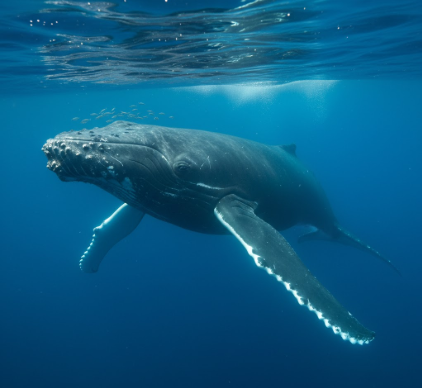
Humpback whales travel up to 16,000 miles annually—the longest migration of any mammal on Earth.
I used to think whales migrated purely for warmth, like retirees heading to Florida. Turns out, it’s way more complicated than that. The real driver is food—or rather, the complete absence of it in tropical waters where humpbacks breed. Antarctic waters contain massive concentrations of krill and small fish during summer months, sometimes reaching densities of 30,000 individual krill per cubic meter. These cold, nutrient-rich seas support the intense feeding humpbacks need to build up blubber reserves. A single adult can consume roughly 3,000 pounds of food daily during peak feeding season. But here’s the thing: those same icy waters become nearly impossible for newborn calves to survive in. The babies lack sufficient blubber insulation and would lose body heat too rapidly in sub-Antarctic temperatures. So mothers travel to warm tropical breeding grounds—places like Hawaii, the Caribbean, or the coast of Colombia—where calves can develop without the metabolic stress of freezing water.
The energy economics are honestly kind of insane. Adult humpbacks essentially fast for months while breeding and raising young in tropical waters that contain almost no food worth eating. They’re running on stored fat reserves the entire time, losing up to a third of their body weight.
Why These Whales Don’t Just Pick One Climate Zone and Stay There Forever
You’d think evolution would favor whales that found a comfortable middle ground, but it hasn’t worked out that way. The problem is that the ocean’s most productive feeding zones—created by upwelling currents that bring nutrients from the deep—are also seasonally variable and concentrated in cold regions. Tropical waters are comparatively barren, what marine biologists sometimes call “ocean deserts.” There’s just not enough prey density to support a 40-ton animal’s caloric needs year-round. Meanwhile, polar and subpolar waters recieve intense summer sunlight that triggers explosive phytoplankton blooms, which feed zooplankton, which feed krill and fish—the whole food chain humpbacks depend on. The whales have essentially adapted to exploit this seasonal abundance rather than settling for mediocre food availability elsewhere.
The Mysterious Phenomenon of Whales That Migrate to the Wrong Hemisphere Entirely
Some individual humpbacks have been documented traveling between feeding grounds in the North Pacific and breeding areas in the South Pacific—crossing the equator twice. Wait—maybe that sounds like a navigation error, but researchers think it might actually be strategic. These trans-equatorial migrants could be exploiting feeding opportunities in both hemispheres, effectively experiencing two summers per year. One female tracked between Costa Rica and Antarctica covered over 18,000 miles in a single year. It’s unclear how common this behavior is, but it definately pushes the boundaries of what we thought humpback migration looked like.
How Newborn Calves Survive Multi-Month Journeys They’ve Never Practiced Before
Here’s where it gets kind of remarkable and also slightly terrifying from a parenting perspective.
Calves are born in warm water weighing around 2,000 pounds and measuring 13-16 feet long. Within hours they’re swimming, but they have zero experience with navigation or the physical endurance required for migration. They simply follow their mothers, nursing constantly to build energy reserves. Mother humpbacks don’t feed at all during this period—they’re simultaneously producing milk (which is about 45-60% fat, incredibly rich), protecting the calf from predators like orcas, and guiding it on a journey of thousands of miles. The calf learns the migration route through this single experience, imprinting the path for future years. By the time they reach feeding grounds, calves have grown substantially and are beginning to supplement nursing with their own foraging attempts. It’s basically a compressed education in long-distance ocean travel with no room for failure.
What Climate Change Is Already Doing to These Ancient Migration Patterns Right Now
Warming ocean temperatures are shifting the timing and location of krill blooms, which means humpbacks are arriving at feeding grounds to find prey distributions different from what they’ve relied on for millennia. Some populations are showing up earlier in the season or exploring new feeding areas. There’s also evidence that warmer breeding ground waters might be less ideal for calves—though honestly, the research is still catching up to how fast things are changing. What’s certain is that these migrations, refined over hundreds of thousands of years, are now facing environmental conditions that are changing faster than whales can adapt.