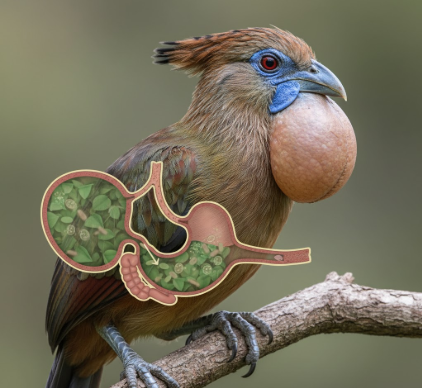
The hoatzin smells like manure and looks like a punk rocker designed by committee.
I’ve spent enough time around livestock to know that distinctive fermentation smell—the one that hits you before you even see the barn. And here’s the thing: hoatzins produce that exact odor because they’ve essentially turned their chest cavity into a cow’s stomach. Their enlarged crop and lower esophagus house bacterial colonies that break down leaves through foregut fermentation, a digestive strategy virtually unknown among birds but standard operating procedure for ruminants like cattle, deer, and goats. The system works, sort of—hoatzins can subsist entirely on leaves, which most birds can’t digest efficiently—but the trade-off is brutal. That fermentation chamber takes up so much space that their flight muscles have atrophied to roughly 13% of their body weight, compared to around 20% in other birds of similar size. They’re terrible flyers, basically.
I used to think this was just a weird evolutionary dead-end, some quirky adaptation that worked well enough in the Amazon basin where hoatzins didn’t face much predation. Turns out the story’s more complicated and considerably older than I’d imagined.
When Birds Borrowed a Digestive Strategy From Mammals That Hadn’t Evolved Yet
The hoatzin lineage split from other birds roughly 64 million years ago, give or take a few million—right around when the dinosaurs checked out and left all these ecological niches sitting vacant. Early hoatzins apparently stumbled into a niche that required processing huge quantities of fibrous plant material, and they solved it by recruiting gut bacteria to do the heavy lifting. What’s genuinely strange is that this happened before most modern ruminant lineages even existed. True ruminants didn’t really diversify until the Eocene, maybe 50 million years ago, which means hoatzins independantly evolved a parallel system first—or at least around the same time, depending on how you read the fossil record. The convergent evolution here is almost unsettling: totally different animals, separated by hundreds of millions of years of evolutionary history, arriving at nearly identical solutions involving multi-chambered fermentation and symbiotic bacteria.
The bacterial communities themselves mirror those found in cow rumens more closely than they resemble bacteria from any other bird species.
Genetic analysis has revealed that hoatzin gut microbiomes contain Methanobrevibacter and other methanogenic archaea—microorganisms that produce methane as a metabolic byproduct. This means hoatzins burp methane, just like cows, though obviously in much smaller quantities given their size. Wait—maybe that’s why they evolved such a reduced flight capacity? The energetic cost of maintaining both fermentation chambers and powerful flight muscles might have been prohibitive, so natural selection favored the compromise we see today: a bird that can barely fly but can digest leaves that would otherwise be nutritionally inaccessible. Some researchers estimate that hoatzins derive roughly 70% of their energy from volatile fatty acids produced by bacterial fermentation rather than from direct digestion, which is comparable to the proportion in ruminants.
The Evolutionary Price of Eating Like a Cow When You’re Technically Still a Bird
Hoatzin chicks are born with functional wing claws—actual tiny dinosaur-style claws on their wing digits—that they use to climb around in branches before they can fly properly. If threatened, the chicks drop into the water below and swim to safety, then use those claws to climb back up once the danger passes. It’s the kind of trait that makes you reconsider what “modern bird” even means, honestly. The adults retain diminished versions of these claws, though they rarely use them.
The fermentation system imposes other costs too. Because hoatzins need to maintain elevated body temperatures to keep their bacterial colonies functioning optimally, they spend significant portions of the day basking in sunlight to regulate their internal fermentation chambers—time that other birds might spend foraging or defending territory. They’re also restricted to habitats near water in tropical regions where leaf availability remains constant year-round. A hoatzin couldn’t survive migration or seasonal food scarcity the way other birds can, not with that digestive system.
I guess what strikes me most is how committed they are to this strategy. Evolution locked them into a pathway that works but comes with absurd constraints. They can’t fly well, they smell terrible, they’re geographically restricted, and they’ve sacrificed metabolic flexibility for the ability to eat something most animals ignore entirely. And yet they persist, these weird fermented birds, belching methane in the Amazon canopy, living proof that convergent evolution doesn’t care about phylogenetic boundaries when physics and chemistry offer only so many solutions to the same problem.