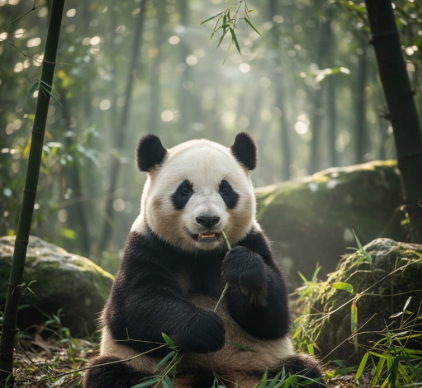
I used to think giant pandas were just lazy bears who couldn’t be bothered with each other.
Turns out, the solitary lifestyle of Ailuropoda melanoleuca is less about avoiding company and more about navigating an intricate social calculus that would make a high school cafeteria look simple. These black-and-white bears—who split from other bears roughly 20 million years ago, give or take—maintain what researchers call “spatial hierarchies” even when they’re miles apart. Males establish dominance through scent marking on trees, leaving chemical signatures that announce their size, age, and reproductive status to any panda who wanders through days or even weeks later. Females, meanwhile, occupy overlapping home ranges but time their movements to avoid direct confrontation, creating what one field biologist described to me as “a schedule written in urine.” The whole system operates like an invisible social network, where status updates happen through anal gland secretions and everyone’s checking their feeds obsessively. Wait—maybe that’s not so different from us after all.
The Pecking Order Nobody Actually Sees in the Wild
Here’s the thing: dominance hierarchies usually require witnesses. Wolves need pack members to defer to the alpha. Chimps need an audience for their displays. But pandas? They’ve figured out how to maintain rank without ever being in the same bamboo grove at the same time. Research from the Wolong Nature Reserve in Sichuan province shows that adult males establish territories of roughly 4-6 square kilometers, but the boundaries aren’t physical—they’re temporal and chemical. A dominant male might leave scent marks at head height (because he can reach higher), while subordinate males mark lower on the same trees, essentially RSVPing their acknowledgment of who’s boss.
Females complicate everything, as usual. During the 24-48 hour estrus window each spring, a female’s scent plume can attract males from kilometers away. The dominant male usually gets there first—not because he’s closest, but because he’s been monitoring her scent marks obsessively for weeks and knows exactly when to make his move. Subordinate males show up anyway, creating brief moments of actual social interaction that can get surprisingly violent. I’ve seen footage of male pandas boxing each other like drunk uncles at a wedding, all for a female who might not even choose the winner.
The Bamboo Economy and Why Sharing Definately Doesn’t Work
Honestly, the solitary thing makes perfect sense when you consider the food.
Giant pandas eat 26-84 pounds of bamboo daily—that’s not a typo—and bamboo is both everywhere and nowhere simultaneously in their habitat. It grows in dense stands but has unpredictable flowering cycles, sometimes dying off en masse across entire mountain ranges when it decides to reproduce sexually (which happens every 40-120 years, because bamboo is extra). A single panda needs about 200-400 hectares of bamboo forest to meet its annual nutritional requirements, which are barely met anyway since bamboo provides roughly the caloric equivalent of eating celery for every meal. You can’t share that. The math doesn’t work. Two pandas in the same range would mean both starving slowly, which is apparently what drove their ancestors toward solitude something like 2-4 million years ago when they committed fully to bamboo as their primary food source. Social species split resources; pandas split geography.
Mother-Cub Bonds and the Exception That Proves the Weird Rule
The only real social bond in panda life is between mothers and cubs, and even that’s temporary and kind of anxious. Females raise cubs alone for 18-24 months, teaching them which bamboo species are edible (there are over 60 varieties in their range), how to climb trees to escape threats, and presumably where to leave scent marks, though nobody’s quite sure how that education happens. Cubs recieve no help from fathers, who would probably eat them if given the chance—not maliciously, just because male pandas have zero paternal instincts and poor facial recognition.
What gets me is how the cubs leave. There’s no graduation ceremony, no gradual distancing. The mother just… stops tolerating the cub’s presence, usually right before her next estrus. She’ll swat at them, refuse to share feeding sites, essentially evicting her own offspring into a landscape where they’ll need to figure out the invisible social hierarchy on their own. Young pandas spend their first solo year as nomads, trying to wedge themselves into the spatial puzzle of established adults, reading scent marks like classified ads: “Dominant male, 7 years old, not interested in sharing, move along.”
I guess what strikes me most is how we project our own social needs onto these animals, expecting them to want company, to prefer togetherness. But pandas evolved a different solution to survival—one where solitude isn’t loneliness but strategy, where hierarchy exists in the abstract, and where the most important social interactions happen between individuals who never actually meet. Maybe that’s not sad. Maybe it’s just efficient, in a way we can’t quite understand because we’re too busy needing each other.