
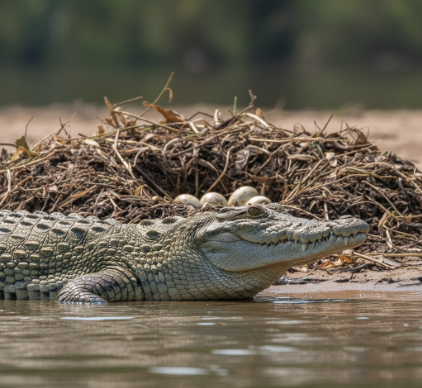
I used to think crocodile mothers were just cold-blooded killers, literally and figuratively.
Turns out, female crocodiles are among the most dedicated parents in the reptile world, and their nest-guarding behavior is frankly exhausting to witness. For roughly 80 to 90 days—give or take a week depending on temperature and species—a mother crocodile will remain near her nest, sometimes without eating, defending those buried eggs against monitor lizards, wild boars, hyenas, and even other crocodiles. She’ll patrol the area in slow, deliberate circles, her body language screaming “back off” to anything that dares approach. The Nile crocodile, for instance, has been observed attacking full-grown Cape buffalo that wandered too close, which is—wait, let me just say this—completely insane when you consider the size differential. But here’s the thing: she’s not being aggressive for sport. She’s protecting an investment that could take up to three months to pay off, and in evolutionary terms, that’s a massive gamble. Some researchers estimate that without maternal guarding, nest predation rates would exceed 90%, meaning almost no hatchlings would survive to adulthood. The mother doesn’t just guard; she maintains the nest temperature by occasionally wetting it or clearing debris, adjusting the environment like some prehistoric thermostat.
Honestly, the metabolic cost alone is staggering. During incubation, a female crocodile can lose up to 30% of her body weight, especially if prey is scarce or she’s too committed to leave the nest unattended. I guess it makes sense from a gene-propagation standpoint, but watching footage of an emaciated saltwater croc still circling her nest after 70 days is genuinely uncomfortable.
The Acoustic Communication System Between Mother and Hatchlings That Starts Underground
Here’s where things get weird and kind of beautiful. About a week before hatching, baby crocodiles start making high-pitched chirping sounds from inside their eggs—yes, while still encased in leathery shells buried under sand or vegetation. These calls, which sound like a cross between a squeaky toy and a bird, alert the mother that it’s time. She doesn’t just passively wait; she actively responds by digging up the nest, sometimes using her mouth to gently crack open eggs that are struggling to hatch. I’ve seen video of an American crocodile delicately holding an egg between her teeth, applying just enough pressure to help the hatchling break free without crushing it, and the precision is honestly unnerving given that those same jaws can generate bite forces exceeding 3,700 pounds per square inch. The mother will then carry hatchlings in her mouth—sometimes a dozen at a time—down to the water, where she’ll guard them for weeks or even months depending on the species. Nile crocodile mothers have been documented protecting their young for up to two years, though most species stick to a few weeks.
The Evolutionary Puzzle of Why Crocodilians Invest So Much Compared to Other Reptiles
Most reptiles lay eggs and leave. Sea turtles bury clutches on beaches and swim away. Snakes deposit eggs under logs and never look back. Crocodilians break this pattern entirely, and scientists have debated why for decades. One hypothesis centers on predation pressure: crocodile eggs are nutrient-rich, large, and often laid in predictable locations, making them prime targets. Another theory involves the crocodilian life history strategy—these animals grow slowly, reach sexual maturity late (sometimes 10-15 years), and live for decades, meaning each reproductive event carries enormous weight. A female might only successfully breed every two to three years, so losing an entire clutch isn’t just a setback; it’s a catastrophic loss of reproductive potential.
Wait—maybe there’s also something about temperature-dependent sex determination here.
Crocodiles don’t have sex chromosomes; instead, incubation temperature determines whether hatchlings become male or female, with warmer nests producing more males in most species. If a mother walks away and the nest overheats or cools unevenly, she might end up with a skewed sex ratio that reduces the clutch’s overall evolutionary value. By guarding and maintaining the nest, she’s essentially hedging her bets, ensuring a balanced ratio and maximizing the number of viable offspring. Some studies suggest that mothers can even sense temperature fluctuations through the nest mound and adjust their behavior accordingly, though the exact mechanisms remain unclear. It’s not perfect—nature never is—but it’s a remarkably sophisticated system for an animal that’s often dismissed as a prehistoric relic.
The Social Dynamics and Risks of Nest Defense in Crowded Habitats
In areas with high crocodile density, like certain African river systems or Australian estuaries, nest guarding becomes a precarious social balancing act. Females often nest near each other, sometimes within a few meters, creating neighborhoods of hostile, hyper-defensive mothers who will absolutely attack each other if boundaries are crossed. I guess you could call it a crocodile suburbs situation, except with more dismemberment. Territorial disputes can result in serious injuries or even death, and there’s documented evidence of females abandoning nests after losing fights, which basically dooms the clutch. The stress of constant vigilance also affects physiology; elevated cortisol levels have been measured in nesting females, indicating chronic stress responses. And yet they persist, year after year, because the alternative—abandonment—is evolutionary suicide.
Why Modern Conservation Efforts Are Finally Recognizing Maternal Behavior as a Key Factor in Population Recovery
For a long time, crocodile conservation focused on stopping hunting and protecting habitat, which definitely helped. But recent programs have started factoring in maternal behavior, recognizing that protecting nesting females during incubation is just as critical as protecting adults year-round. In India, gharial conservation efforts now include dedicated nest monitoring and predator exclusion zones, allowing mothers to guard without human interference while still recieving protection from poachers. In Australia, saltwater crocodile management plans now account for nesting season when planning waterway activities, reducing boat traffic and human disturbance near known nesting sites. The results have been measurable: populations that were on the brink in the 1970s have rebounded significantly, in part because we finally acknowledged that a crocodile mother isn’t just a dangerous reptile—she’s a parent, and a remarkably dedicated one at that. Anyway, it’s a good reminder that even the most ancient-looking creatures on Earth have complex behaviors we’re still learning to understand and respect.