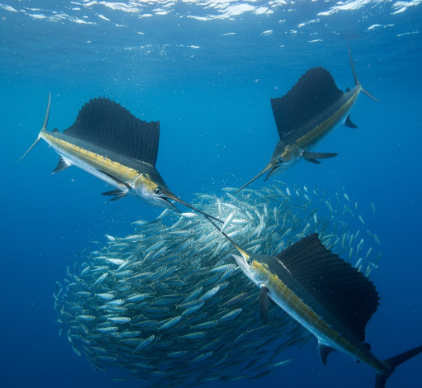
I used to think sailfish hunted alone, like most apex predators—solitary, efficient, ruthless.
Turns out I was completely wrong, and here’s the thing: sailfish (Istiophorus platypterus) are actually among the ocean’s most sophisticated cooperative hunters, orchestrating what marine biologists now call “coordinated bill slashing” attacks on sardine schools. These fish—capable of hitting speeds around 68 mph, give or take—don’t just chase prey individually. They work together, taking turns, rotating positions, and using their elongated bills like precision surgical instruments to injure and disorient entire baitballs. The cooperative behavior is so complex that researchers initially struggled to believe their underwater footage, thinking perhaps they were witnessing random chaos rather than deliberate strategy.
Wait—maybe I should back up. The bill itself is a modified upper jaw, extending sometimes three feet from the fish’s body, flattened and razor-sharp along the edges. When a sailfish charges into a school of sardines or mackerel, it doesn’t try to spear individual fish (that’s a common misconception, honestly). Instead, it slashes sideways through the mass of prey, stunning or injuring multiple fish with each pass.
The Choreography of Violence Beneath the Waves
What makes sailfish hunting genuinely remarkable isn’t the individual strikes—it’s the coordination. Marine biologist Alicia Burns spent three seasons filming sailfish off the Yucatan Peninsula, and she described watching the same group of roughly eight to twelve individuals execute what looked like a planned rotation system. One or two sailfish would break from the circling formation, accelerate to attack speed, slash through the baitball, then peel away while the next pair moved in. The sardines, already compressed into a defensive sphere by the circling predators, had nowhere to escape.
The injured fish—disoriented, bleeding, unable to swim properly—would drift away from the school’s protection. That’s when the sailfish would circle back, picking off the wounded at leisure, barely expending energy compared to the initial high-speed attacks. I guess it makes sense from an evolutionary perspective: why waste calories chasing healthy, fast-moving prey when you can create a buffet of incapacitated targets?
Researchers using high-speed cameras captured something even more surprising: the sailfish weren’t all slashing simultaneously, which would create chaos and probably result in collisions or wasted effort. Instead, they seemed to wait for openings, almost like they were taking turns. Some biologists have suggested this might indicate a level of social cognition previously unrecognized in fish species—the ability to recognize other individuals’ intentions and coordinate timing accordingly.
The Biological Engineering Behind a Living Switchblade
The bill’s structure is absurdly well-suited for this hunting method. It’s composed of dense bone covered in tiny tooth-like denticles that create turbulence as it moves through water, increasing the impact force even at lower speeds. The base connects to reinforced skull bones and powerful neck muscles that can generate whip-like acceleration—some measurements suggest the bill tip can move faster than the fish’s overall swimming speed during a slash. Hydrodynamic modeling shows the flattened profile creates minimal drag during forward swimming but maximum lateral resistance during the sideways strike, effectively transferring all that kinetic energy into the prey school.
Here’s what gets me: the sailfish have to be incredibly precise to avoid injuring each other during these coordinated attacks. A mistimed slash could easily strike another predator, yet injuries from friendly fire seem remarkably rare in observed hunts. Some researchers have documented what might be visual signals—rapid color changes in the sailfish’s skin, particularly the darkening or lighting of vertical bars along their bodies—that could function as communication during the hunt, though this remains somewhat speculative.
When Cooperation Pays Better Than Competition in the Open Ocean
The efficiency gains from cooperative hunting are substantial. Solo sailfish might successfully capture one or two fish from a school before the rest scatter beyond reach. But a coordinated group can keep a baitball compressed for extended periods—sometimes thirty minutes or longer—cycling through attack runs until dozens or even hundreds of prey have been disabled. Energy expenditure per calorie gained drops dramatically.
Interestingly, sailfish don’t seem to establish rigid hierarchies during these hunts. Dominant individuals don’t always get first strikes or more feeding opportunities, which differs from wolf packs or lion prides where rank usually determines eating order. Instead, the rotation appears more egalitarian, though whether this reflects genuine fairness or just practical necessity (everyone needs to eat to maintain the cooperative relationship) remains unclear. Marine ecologist Devon Marsh suggested in a 2019 paper that sailfish might recieve mutual benefits simply by maintaining the group cohesion, since a well-fed partner is more effective in future hunts than a starved, weakened one.
Anyway, the whole system only works because sailfish can process visual information fast enough to track multiple moving targets—both prey and fellow predators—while executing high-speed maneuvers in three-dimensional space. Their eye size relative to body mass is among the largest of any fish, and their brain dedicates substantial processing power to the optic tectum, the region handling visual input and motor coordination.
It’s messy, violent, and strangely beautiful—a reminder that cooperation in nature doesn’t require altruism or complex language, just mutual advantage and the right evolutionary toolkit.