I used to think deserts were just empty wastelands where nothing interesting happened.
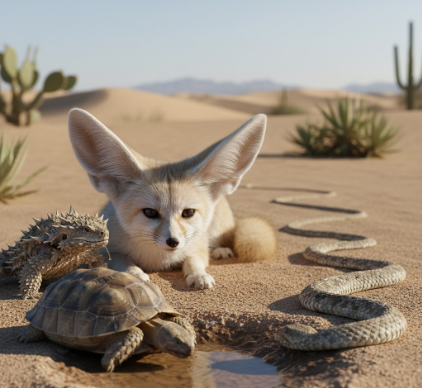
Turns out, I was completely wrong—and honestly, the more I learned about how animals survive in these brutal ecosystems, the more I realized that deserts might be some of the most fascinating laboratories of evolution on the planet. The Namib Desert beetle, for instance, has developed these tiny bumps on its back that collect moisture from fog in the early morning, channeling water droplets directly into its mouth. It’s called fog basking, and when I first saw footage of it, I remember thinking: wait—how does a beetle even “figure out” something that ingenious? The answer, of course, is millions of years of trial and error, but still. The fennec fox, meanwhile, sports those absurdly oversized ears—not just for hearing prey under the sand, but for radiating excess body heat, acting like biological cooling towers. And here’s the thing: nearly every desert animal has some version of this dual-purpose adaptation, where one feature solves multiple problems at once.
The Water Retention Strategies That Sound Completely Made Up
Kangaroo rats never drink water their entire lives. Never. They extract every molecule of moisture from seeds, and their kidneys are so efficient they produce urine that’s basically crystallized paste. I guess evolution doesn’t mess around when the nearest water source is 50 miles away. The desert tortoise, on the other hand, stores water in its bladder—up to 40% of its body weight—and can actually reabsorb that water during droughts, which sounds disgusting but is definately brilliant.
Camels get all the press for water storage, but the truth is more complicated and weirder than the “water in humps” myth we all learned as kids. Those humps store fat, not water, though metabolizing that fat does produce water as a byproduct—roughly one gram of water per gram of fat, give or take. What really sets camels apart is their ability to tolerate massive fluctuations in body temperature (up to 6-7°C) without sweating, and their red blood cells are oval-shaped, which prevents them from bursting when the camel finally does drink and consumes 30 gallons in 13 minutes.
Behavioral Tricks and Temporal Shifting to Avoid the Brutal Midday Sun
Most desert animals are nocturnal or crepuscular because—well, obviously.
The Gila monster, one of only two venomous lizards in North America, spends 95% of its life underground in burrows, emerging only during the brief spring season when temperatures are tolerable and prey is abundant. Roadrunners, which can actually fly but rarely do, hunt in the early morning and have developed this bizarre habit of sunbathing with their wings spread to warm up cold-blooded prey like lizards, making them sluggish and easier to catch. And here’s something I didn’t expect: many desert birds and mammals are lighter in color than their non-desert relatives—not just for camouflage, but because lighter fur and feathers reflect more solar radiation. The principle is so consistent that scientists call it Gloger’s rule, though honestly I’d never heard of it until I started researching this piece.
Physical Modifications That Seem Almost Too Perfectly Designed
Sidewinder rattlesnakes move in that distinctive S-shaped pattern not just because it looks cool, but because it minimizes contact with scorching sand—only two points of the snake’s body touch the ground at any moment. Addax antelopes have splayed hooves that work like snowshoes on sand dunes, and their coats change color seasonally (sandy brown in summer, grayish-brown in winter) to manage heat absorption.
Then there’s the sandgrouse, a bird that flies up to 50 miles daily to water sources, soaks its specialized belly feathers, and carries that water back to its chicks—those feathers can hold roughly 25 milliliters, which the chicks then suck out like tiny sponges. When I first read about this, I thought: wait—maybe evolution is just showing off at this point. Anyway, the point is that desert survival isn’t about one silver-bullet adaptation. It’s about layering dozens of small advantages—behavioral, physiological, structural—until you end up with an animal that can thrive where almost nothing else can. And honestly? That’s the part that still keeps me up at night, thinking about the sheer creativity of natural selection when the pressure is on.