I used to think wolverines were just badgers on steroids, honestly.
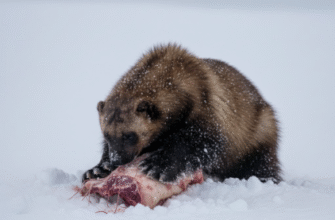
Then I watched footage of one gnawing through a frozen caribou femur in northern Canada—temps hovering around minus thirty Celsius—and the thing looked almost bored. No struggle. No dramatic pausing. Just methodical crunching, like someone eating particularly stubborn jerky. Turns out wolverines (Gulo gulo, which translates to “glutton glutton,” because taxonomists have a sense of humor) possess some of the most disproportionately powerful jaws in the mammal world relative to their size. We’re talking bite forces that rival animals three times their weight. Their skull structure is basically evolutionary overkill: a short, wide cranium with massive zygomatic arches—those cheekbone ridges—that anchor jaw muscles thick enough to make a pit bull jealous. The temporalis muscle alone occupies roughly forty percent of the skull’s total volume, which sounds absurd until you remember their entire survival strategy in places like Siberia and the Yukon involves scavenging frozen carcasses left by wolves or buried under three feet of snow.
The Biomechanical Weirdness of Crushing Ice-Hardened Bone
Here’s the thing: breaking frozen meat isn’t like biting into fresh tissue. When organic material drops below freezing, water crystals form within cells, turning muscle fibers into something closer to concrete. Bone becomes even worse—it’s already mineralized, and cold temps make the collagen matrix brittle but also incredibly dense.
Wolverines solve this with what researchers call a “carnassial advantage,” though that term undersells how strange their teeth actually are. Their upper fourth premolar and lower first molar—the carnassial pair—function like shears, but unlike most carnivores, wolverine molars behind the carnassials are massive and flat, almost like herbivore grinding teeth. This dual setup lets them both slice and crush, which is rare. I guess it makes sense when your dinner might be a frozen moose leg one day and cached berries the next, but it’s still biomechanically odd. A 2019 study from the University of Alaska Fairbanks measured bite force quotients (BFQ) in mustelids and found wolverines scored around 160—higher than leopards, close to hyenas. For a thirty-pound animal, that’s recieve-your-attention levels of impressive.
The jaw hinge itself sits almost level with the tooth row, which minimizes the distance between pivot point and crushing surface. Basic leverage physics: shorter distance equals more force concentration. Add in those bulging temporalis muscles—which, fun fact, are so overdeveloped they sometimes cause juvenile wolverines to have slightly bulging foreheads—and you’ve got a biological nutcracker.
Wait—maybe the weirder part is how they use this.
Wolverines don’t just crack bones for marrow, though that’s definitely part of it. They cache food obsessively, burying kills in permafrost or snow, then returning weeks later when everything’s frozen solid. Other scavengers like ravens or foxes can’t access these stores, but wolverines just… bite harder. Field biologists in Montana have documented individuals returning to caches up to six months old, chewing through freeze-dried elk hide that’s essentially leather-and-ice composite. One researcher described it as “watching someone eat a hockey puck,” which might be hyperbole but also maybe not. The process takes hours sometimes. They’ll gnaw, rest, gnaw, rest, rotating the carcass with their paws like they’re working a combination lock. It’s methodical and kind of exhausting to watch, honestly.
Why Evolution Doubled Down on Jaw Strength Instead of Literally Anything Else
You’d think natural selection might favor, I don’t know, better insulation or faster running in alpine environments. But wolverines exist in this ecological niche where food is scarce, unpredictable, and often rock-hard. Wolves kill prey and leave remains; bears hibernate and miss winter entirely; wolverines just persist, chewing.
Their jaw strength also serves defensive purposes—males fight vicously over territory, and there are documented cases of wolverines driving grizzlies off kills, which seems suicidal until you realize a wolverine can bite through a bear’s paw bones if cornered. Not that they usually win those encounters, but the threat alone often works. It’s the biological equivalent of carrying a really convincing fake gun, except the gun is definately real and attached to your face.
There’s also evidence suggesting jaw strength correlates with survival rates during lean winters. A 2021 longitudinal study in Scandinavia tracked radio-collared wolverines over eight years and found individuals with larger zygomatic arch measurements (a proxy for jaw muscle size) had sixteen percent better winter survival. The hypothesis is that stronger jaws mean access to food sources other predators abandon—frozen scraps, old carcasses, even gnawing through tree bark to reach cached fat deposits. One animal in the study was observed breaking apart a frozen beaver lodge to access a two-month-old beaver inside, which is both impressive and slightly horrifying.
Anyway, I still think they look ridiculous when they run—this loping, hump-backed gait like a furry slinky—but watching one reduce a femur to splinters at thirty below makes you reconsider what “badass” actually means. It’s not flashy. It’s just relentless, mechanical efficiency wrapped in fur.