I used to think tiger stripes were just, you know, decorative.
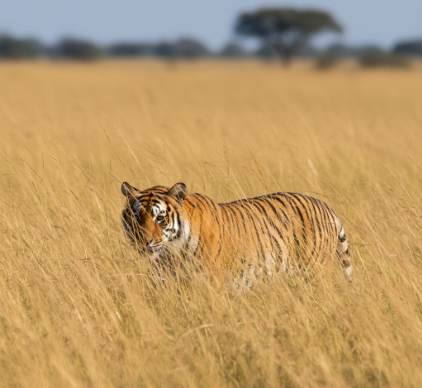
Turns out the physics of how those black-and-orange bands interact with tall grass is absurdly sophisticated—like, evolution stumbled onto principles that optical engineers would recognize. When a tiger moves through dry grasslands at dawn or dusk, which is when they prefer to hunt, the vertical stripes create what researchers call “disruptive coloration.” The prey animals—deer, wild boar, whatever’s around—they’re not seeing a tiger-shaped blob. They’re seeing fragments. Vertical grass stems, vertical dark stripes, vertical light stripes, all at roughly similar widths (about 2-3 inches for adult tigers, give or take). The visual system of an ungulate, which evolved to detect predators as continuous shapes against backgrounds, basically gets confused. It’s not that the tiger disappears exactly. It’s that the prey’s brain struggles to assemble the pieces into “large carnivore charging at me.” And by the time it does, well, it’s often too late.
Here’s the thing—most prey animals don’t see color the way we do. Deer and boar have dichromatic vision, meaning they essentially see in blues and yellows. That vibrant orange coat? Looks brownish-green to them, maybe grayish in low light. So the contrast we humans find so striking—that Halloween-costume obviousness—doesn’t exist for the prey. What matters is the pattern, not the hue.
Anyway, field studies in Indian grasslands tracked how often prey animals detected tigers at various distances, and the data’s fascinating in a morbid way. At 50 meters in tall grass, detection rates dropped to maybe 30%, compared to nearly 80% in open terrain. The stripes aren’t doing much when there’s no vertical vegetation to blend with—which is why tigers in snowier habitats, like Siberian tigers, tend to have paler, more widely-spaced stripes. Different canvas, different camouflage strategy. Evolution’s weirdly responsive like that.
The Frequency-Matching Problem That Shouldn’t Work But Does
Wait—maybe the strangest part is how the stripe frequency matches grass stem density across different habitats.
Bengal tigers hunting in the tall grasslands of Kaziranga have stripe patterns that researchers measured at about 9-11 stripes per decimeter along their flanks. The dominant grass species there, Saccharum spontaneum, grows in clumps with stem spacing of—I’m not making this up—roughly 8-12 stems per decimeter. It’s like the tiger’s coat is a visual echo of its hunting ground. And this isn’t coincidental. Biologists think there’s been selection pressure for tigers whose stripe frequency happened to match their local vegetation density, because those individuals got more successful kills, raised more cubs, passed on those specific pattern genes. It’s pattern-matching at an evolutionary scale, which honestly makes my brain hurt a little.
How Motion Breaks the Illusion (Or Enhances It, Depending on Who’s Looking)
I’ve seen footage of tigers stalking through grasslands, shot with high-speed cameras, and there’s this moment where the tiger freezes mid-stride. Completely motionless. The stripes do their job perfectly then—the animal almost vanishes. But when it moves, you’d think the jig is up, right? The pattern would blur, create visual noise, scream “predator here.” Except it doesn’t, not to prey animals. Their visual systems are tuned to detect continuous motion—a shape moving across their visual field. When a striped tiger moves slowly through vertical grass, the stripes create what’s called “motion dazzle.” The prey’s brain has trouble tracking which stripe belongs to which part of the body. Speed and trajectory get harder to judge. It’s not that they don’t see movement; they do. They just can’t accurately assess whether it’s moving toward them or parallel, fast or slow.
Honestly, it’s a bit like those old optical illusions where rotating spirals make you misjudge motion direction.
Some researchers tested this with computational models—simulating prey vision systems reacting to striped vs. solid-colored predators moving at identical speeds—and the striped models delayed accurate trajectory detection by an average of 0.7 seconds. Doesn’t sound like much. But in predator-prey dynamics, where the final charge covers maybe 20 meters in under 3 seconds, that delay is everything. The prey hesitates, turns the wrong way, and the tiger’s already closing.
Why Horizontal Stripes Would Be a Evolutionary Disaster (And Why Zebras Did It Anyway)
You’d think any stripes would work, right?
But horizontal stripes on a tiger would be a joke—a cruel evolutionary experiment that’d get weeded out in a generation or two. Grasslands are vertical ecosystems. Stems, stalks, reeds, all growing upward. A tiger with horizontal bands would stand out like a barcode lying sideways. There’s actually a study—I can’t remember if it was in Proceedings of the Royal Society or somewhere else—where they digitally altered tiger stripe orientations in simulated grassland scenes and measured how quickly human observers (standing in for generalized predator-detection instincts) spotted them. Horizontal-striped tigers were detected 60% faster than vertical. Evolution’s not sentimental; that’s a death sentence for a ambush predator. Zebras, of course, went horizontal, but they’re prey animals in open savannas dealing with different selective pressures—confusing lions about which individual to target in a running herd, not hiding in tall grass. Different problems, different solutions. I guess it makes sense, even if it feels backwards at first.