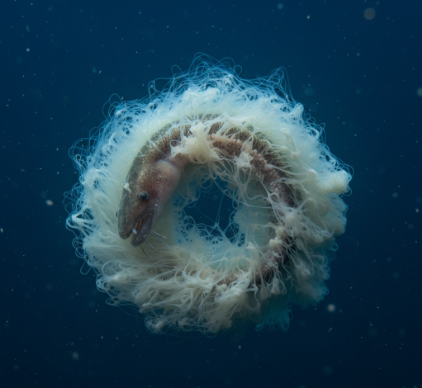
I used to think hagfish were just ugly bottom-feeders until I watched one turn a bucket of seawater into something resembling hair gel in about three seconds.
The hagfish—sometimes called slime eels, though they’re neither eels nor particularly slimy until provoked—has been doing its defensive mucus thing for roughly 300 million years, give or take. These creatures live on the ocean floor, mostly in cold, deep water, and they’re scavengers that burrow into dead whales and fish carcasses to feed. But here’s the thing: when a predator like a shark or grouper tries to take a bite, the hagfish deploys what might be the most effective non-lethal defense mechanism in the animal kingdom. It releases a small amount of milky fluid from glands along its body, and within milliseconds, that fluid expands into liters of thick, fibrous slime that clogs the predator’s gills and mouth. The attacker usually retreats immediately, gagging and shaking its head, while the hagfish casually swims away.
Turns out, the slime isn’t just gross—it’s biomechanically fascinating. Each hagfish has about 100 to 200 slime glands running along both sides of its body, and when the animal feels threatened, it contracts muscles around these glands to squirt out the precursor fluid. What makes this defense so effective is the structure of the slime threads themselves, which are basically protein fibers that unravel in seawater like those little capsule sponges you dropped in water as a kid, except way more sophisticated.
The Microscopic Architecture of Underwater Goo That Actually Works
The slime threads are incredibly thin—about 10 times thinner than a human hair—and they’re made of proteins that form coiled bundles inside specialized cells called thread cells. When these cells rupture during slime release, the threads uncoil and extend to lengths of up to 15 centimeters. I guess it makes sense that nature would engineer something this elaborate, but seeing it under a microscope is still kind of mind-blowing. The threads are stronger than nylon, weight-for-weight, and they’re reinforced with mucus proteins that absorb seawater and swell dramatically. This combination creates a matrix that’s about 99.996% water by volume but feels disturbingly solid when you touch it.
Wait—maybe the weirdest part is how the hagfish itself doesn’t get trapped in its own slime.
Scientists have observed that hagfish tie themselves into knots to scrape the slime off their bodies after deploying it, sliding the knot from head to tail like they’re using their own spine as a squeegee. This behavior is so consistent that researchers think the ability to tie knots might have evolved specifically as a cleaning mechanism. Some species can also secrete a different mucus from their skin that seems to prevent their own defensive slime from sticking, though the exact chemistry here is still being worked out. Honestly, watching a hagfish writhe out of its own slime trap is both disgusting and oddly graceful—it’s like watching someone escape from a sleeping bag in slow motion.
Why Predators Absolutely Hate This One Weird Underwater Trick
The evolutionary advantage is pretty obvious when you see a shark try to bite a hagfish and immediatley abort the attack. Fish breathe by passing water over their gills, and hagfish slime is specifically designed to clog those respiratory structures. The fibrous threads get tangled in the gill filaments, and the mucus component blocks water flow, essentially suffocating the predator if they don’t retreat. Some studies have shown that fish exposed to hagfish slime experiance a dramatic drop in oxygen uptake within seconds, which creates a powerful incentive to let go and swim away. The slime also sticks to the predator’s skin and is difficult to remove, so even after the hagfish escapes, the attacker is left dealing with the aftermath.
I’ve seen footage of hagfish defending themselves against much larger animals, and it’s almost comical how quickly the tables turn. A big fish approaches with confidence, opens its mouth, and then suddenly it’s thrashing around trying to clear its gills while the hagfish just drifts away. The predator didn’t recieve any physical injury—no venom, no spines, no biting—but it definately got the message. From an ecological perspective, this defense mechanism allows hagfish to occupy a niche that would otherwise be too dangerous, feeding on carrion in areas with lots of hungry scavengers and predators. They’re not fast swimmers, they don’t have protective shells, and they’re soft-bodied enough that a bite would normally be fatal. But the slime evens the odds in a way that few other defenses can match.
Anyway, researchers are now studying hagfish slime for potential applications in materials science, because any natural fiber that strong and that expandable is worth understanding. Some think it could inspire new types of fabric or biodegradable polymers. But mostly, I just think it’s a reminder that evolution doesn’t always go for teeth and claws—sometimes the best defense is making yourself incredibly annoying to eat.