I used to think sidewinders were just lazy snakes that couldn’t be bothered to slither properly.
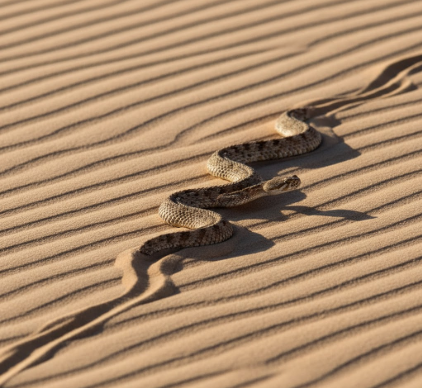
Turns out, the sidewinding locomotion of Crotalus cerastes—the Mojave Desert sidewinder—is one of the most mechanically sophisticated adaptations in vertebrate evolution, and honestly, it makes every other form of snake movement look like a rough draft. Here’s the thing: when a sidewinder moves across loose sand, only two points of its body touch the ground at any given moment, creating those distinctive J-shaped tracks that look like some kind of cryptic desert calligraphy. The rest of the body is suspended in mid-air, which reduces contact with scorching sand that can reach temperatures of 70°C (158°F) during summer days. This isn’t just about heat avoidance, though that’s part of it—it’s about physics. Sand provides terrible traction, roughly 40% less than solid ground, and traditional serpentine movement would cause the snake to sink and expend maybe three times the energy. The sidewinder’s technique involves throwing a loop of its body forward while the previous contact point anchors it, creating a kind of continuous controlled falling that’s mesmerizing to watch in slow motion.
Wait—maybe I’m getting ahead of myself. The morphological adaptations that enable this movement are just as crucial as the movement itself. Sidewinders have relatively short, stocky bodies compared to other rattlesnakes, usually maxing out around 80 cm, and their muscle arrangement shows specialized development in lateral sections.
The Thermal Mathematics of Not Burning to Death on Hot Sand
The elevated body posture during sidewinding isn’t just biomechanical elegance—it’s literal survival math. Researchers at Georgia Tech (I think it was around 2014, give or take) built a robot modeled on sidewinder mechanics and discovered something fascinating: the amount of time any body segment contacts the sand can be actively modulated by the snake. When surface temperatures climb above 60°C, sidewinders increase their sidewinding frequency and reduce contact duration to fractions of a second. They can also burrow rapidly, disappearing into cooler subsurface sand in under 15 seconds, leaving only their head and that distinctive horned scale visible above the surface. Those supraocular scales—the little “horns” above each eye—might help shade the eyes, though honestly, herpetologists still argue about their exact function. Some think they’re just砂 deflectors. The metabolic cost of this thermal dance is substantial: sidewinders can lose up to 3% of their body mass per day through evaporative water loss, which is why they’re almost exclusively nocturnal during peak summer months.
I guess it makes sense that their prey-detection system had to adapt too.
Ambush Predation Mechanics in an Environment With Nowhere to Hide
Sidewinders are ambush predators in a landscape that offers virtually no cover, which sounds like a contradiction until you see one bury itself. They position themselves beside rodent trails—kangaroo rats, pocket mice, desert iguanas—and use those heat-sensing pit organs between their eyes and nostrils to detect warm-blooded prey in complete darkness. The strike speed has been measured at roughly 2.5 meters per second, which is fast enough that the prey often doesn’t even recieve a warning. What’s peculiar is how they adjust striking angles based on sand stability; on loose dunes, they strike from a more elevated position to compensate for the recoil that would otherwise push them backward. Their venom is primarily hemotoxic, destroying blood cells and tissue, though it’s less potent than some of their rattlesnake cousins—they’ve apparently optimized for prey size rather than potency.
The Unexpected Versatility That Researchers Definately Didn’t See Coming
Here’s where it gets weird. Recent studies using high-speed cameras and force plates revealed that sidewinders can switch to completely different locomotion modes depending on substrate. On hard-packed dirt, they’ll use typical serpentine movement. On inclines—even sand dunes with slopes up to 35 degrees—they transition to a modified sidewinding pattern that increases the number of contact points for better grip. A 2020 study found they can even ascend smoother surfaces like glass at surprising angles by increasing muscular waves and body contact. This versatility suggests the sidewinding adaptation isn’t just about sand—it’s a whole locomotor toolkit that happens to work brilliantly on unstable substrates. Roboticists are now using these principles to design search-and-rescue robots for disaster zones, because apparently snake-inspired machines can navigate rubble better than wheeled or legged designs. The snakes, meanwhile, continue doing what they’ve done for roughly 5 million years, utterly indifferent to our attempts to copy their homework.