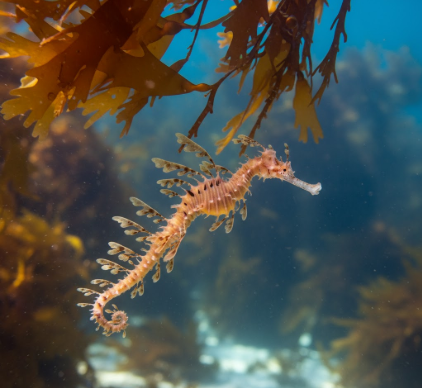
I used to think leafy sea dragons were just fancy seahorses with too much going on.
Turns out, these creatures—native to the southern and western coasts of Australia—have evolved one of the most sophisticated floating mechanisms in the ocean, and it’s all in service of looking like absolutely nothing at all. Their bodies are covered in leaf-like appendages that sway with the current, mimicking kelp and seaweed so convincingly that even experienced divers will swim right past them. But here’s the thing: staying motionless in water isn’t easy. Most fish have to constantly adjust their position, flicking fins or adjusting their swim bladder to compensate for currents, salinity changes, and their own metabolism. Leafy sea dragons, though, have figured out how to hover in place for hours, barely moving a muscle, and the physics behind it are honestly kind of exhausting to think about.
The secret starts with their swim bladder, which they can inflate or deflate with remarkable precision. They’re adjusting buoyancy in real-time, compensating for even the tiniest shifts in water density. It’s like they’re constantly recalibrating their internal ballast system, except they’re doing it while pretending to be a piece of drifting seaweed.
Their Leafy Appendages Aren’t Just for Show—They’re Drag Anchors
Those elaborate, frond-like projections aren’t just camouflage decoration.
They also function as passive drag elements, slowing the animal’s movement through water and making it easier to maintain position without expending energy. When a current hits a leafy sea dragon, those appendages catch the water flow and distribute resistance across the body, which—wait, maybe I’m oversimplifying this—essentially turns the dragon into a living drift anchor. The leafy bits don’t contain bones or muscles; they’re just skin and connective tissue, which means they move independently of the animal’s will, responding to water movement in a way that makes the dragon look even more like floating vegetation. I guess it’s a kind of evolutionary trick where the camouflage itself becomes part of the mechanical system. The dragon doesn’t have to work to look natural; the ocean does it for them.
Anyway, researchers have measured the drag coefficient of these appendages and found they’re optimized for a very specific speed range—roughly the speed of drifting kelp in moderate current. Too fast, and the disguise breaks. Too slow, and predators notice the lack of movement.
Micro-Adjustments with Transparent Fins That Basically Don’t Exist
Leafy sea dragons have tiny, almost invisible pectoral and dorsal fins that flutter at frequencies up to 10 times per second. These fins are so translucent and so small that they’re easy to miss entirely, but they’re doing a huge amount of work. When the dragon needs to adjust its position—say, to rotate slightly or drift a few centimeters to the left—it uses these fins in short, controlled bursts. The movements are so subtle that they don’t disrupt the overall illusion of motionlessness. I’ve seen footage of this, and honestly, it’s unnerving how little they move while still maintaining perfect positional control. It’s like watching someone hold their breath underwater while simultaneously doing mental math. The energy cost is minimal because the fins are only active for fractions of a second at a time, but the cumulative effect is total spatial stability.
There’s also evidence—though not definately conclusive yet—that the dragons can sense minute pressure changes through their lateral line system and adjust preemptively, before a current even reaches them. It’s predictive floating, which sounds absurd but makes sense when you consider how exposed they are in open water.
They’re Essentially Biological Submarines with Kelp Costumes
The whole system—swim bladder adjustments, passive drag appendages, micro-fin corrections—works together like a distributed control network. No single part does the job alone, and if any one element fails, the camouflage breaks down. Predators like sharks and large fish rely heavily on motion detection, so even a slight wobble or drift at the wrong speed can trigger an attack. Leafy sea dragons have evolved to exist in this incredibly narrow performance envelope where they’re neutrally buoyant, visually indistinguishable from plants, and mechanically stable enough to hold position in variable currents. It’s exhausting just thinking about the selective pressure required to produce this. And yet, they do it so effortlessly that most people who see them assume they’re just… sitting there. Which, I guess, is exactly the point.