I used to think wildebeest were basically just awkward-looking cows with bad PR.
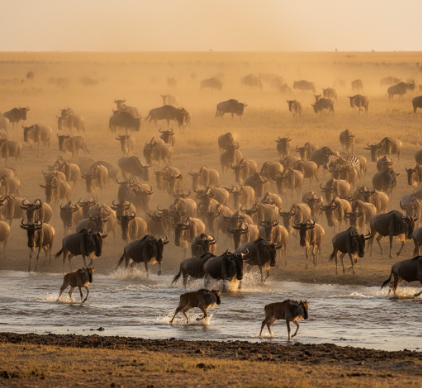
Then I spent three weeks following the migration through the Serengeti, and honestly, I still think they look ridiculous—those spindly legs, that perpetually surprised expression—but the sheer scale of what they do every year is staggering. We’re talking about roughly 1.5 million animals moving in a circuit that spans around 1,800 miles, give or take, through Tanzania and Kenya, driven by rainfall patterns that have shaped this journey for something like 1 million years, maybe more. The thing is, they’re not just wandering aimlessly; they’re following the rains with a precision that scientists are only now beginning to understand, using some combination of smell (they can detect rain from dozens of miles away, apparently), memory, and what one researcher I spoke with called “collective intelligence,” though she admitted that term might be giving them too much credit. It’s messy, chaotic, and somehow it works—most years, anyway.
Here’s the thing: the migration isn’t actually a circle, even though everyone describes it that way. The herds move in response to grass growth, which depends on rain, and rain in East Africa doesn’t follow a schedule. Some years the wildebeest arrive at the Mara River in July; other years it’s September, and by then the crocodiles are practically starving.
The Mara River Crossing: Chaos Theory in Action, Basically
The Mara River crossings are what everyone comes to see, and they’re genuinely horrifying in person. Thousands of wildebeest pile up on the banks, hesitating for hours—sometimes days—before something (nobody really knows what) triggers the plunge. They hurl themselves off cliffs that are eight, ten, sometimes fifteen feet high, landing in water churning with crocodiles that can weigh over a thousand pounds. I watched one crossing where the animals were trampling each other in the current, and a young calf got swept downstream, and its mother just… kept going. Which sounds cruel, but the alternative is stopping, and stopping means dying. The researchers I talked to estimated that around 6,500 wildebeest drown or get killed at river crossings each year, and their bodies actually become a major nutrient source for the ecosystem—something like 1,100 tons of biomass dumped into the river system annually, which feeds everything from fish to vultures to bacteria that then fertilize downstream plant growth. Wait—maybe that’s the point? One ecologist told me the migration isn’t really about the wildebeest surviving; it’s about them feeding everything else.
Anyway, the predators know the schedule better than most safari guides. Lions in the western corridor time their breeding so cubs are born right when the herds pass through. Hyenas follow the back of the migration, picking off the weak.
Why They Can’t Just Stay Put Where the Grass Is Good
You’d think they could just find a nice spot with permanent water and stay there, but the Serengeti doesn’t work like that. The volcanic soil in the southern plains—near Ngorongoro—is incredibly rich in nutrients, especially phosphorus and calcium, which nursing mothers desperately need for milk production. That’s why around 400,000 calves are born there every February, usually within a two-to-three-week window, which is its own kind of strategic brilliance: predators can only eat so many newborns before they’re literally too full to hunt. But those southern plains dry out completely by May or June, and then the herds have no choice but to move north toward the permanent water sources in the Maasai Mara, even though the grass there is taller and less nutritious. I guess it makes sense from an evolutionary perspective, but watching a heavily pregnant female walk 200 miles because the rain didn’t come feels less like strategy and more like desperation. Climate change is already shifting rainfall patterns, and some conservationists worry the migration could collapse within our lifetimes if the timing gets too unpredictable—which would be catastrophic not just for wildebeest but for the entire ecosystem that depends on them, from dung beetles to tourist economies.
The whole thing is this massive, ancient rhythm that’s also incredibly fragile. Turns out nature’s greatest spectacles are usually one bad decade away from falling apart.