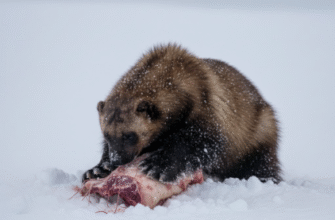
I used to think wolverines were just scrappy weasels with good PR.
Then I watched footage of a single wolverine—maybe 30 pounds soaking wet—drive a black bear off a caribou carcass in northern Canada, and I had to reconsider everything I thought I knew about size mattering in the animal kingdom. The bear outweighed the wolverine by at least 300 pounds, probably more, and it just… left. Backed away like it had somewhere better to be. Which, honestly, it probably did, because wolverines don’t bluff. They’re built like compact muscle grenades with jaws that can crunch through frozen bone, and they possess this unsettling combination of fearlessness andCalculating aggression that makes them punching way above their weight class. Their scientific name, Gulo gulo, literally means “glutton glutton,” which feels less like taxonomy and more like a warning label.
The Biomechanical Advantage of Being Ridiculously Dense
Here’s the thing about wolverines: they’re not small because they’re weak. They’re small because they’re optimized for a specific ecological niche that rewards density over bulk. A wolverine’s body is roughly 65% muscle mass—compare that to humans at around 40%—and their skeletal structure is disproportionately robust for their size. I’ve seen museum specimens where the skull alone looks like it belongs to an animal twice as large. The jaw muscles attach way up on the skull, giving them a bite force quotient (BQ) estimated around 150, which puts them in the same league as much larger carnivores like jaguars. For context, wolves clock in around 136. Wait—maybe that’s not fair, because wolves hunt in packs and rely on endurance, whereas wolverines are solitary ambush specialists who need to disable prey quickly or defend food caches from competitors who could absolutely kill them if things went sideways.
Their paws are disproportionately large, functioning like natural snowshoes that give them mobility advantages in deep snow where larger predators flounder. This lets them access carrion and hunt prey in conditions where they’re essentially unopposed. Efficiency matters more than raw power when you live in environments where calories are scarce and every injury could be fatal.
Psychological Warfare Wrapped in Fur
Anyway, the physical adaptations only tell half the story.
Wolverines have this reputation among wildlife biologists—and I guess among anyone who’s spent time in wolverine country—for being inexplicably, almost pathologically aggressive when defending resources. Not in a rabid way, but in a calculated “I will make this cost you more than it’s worth” way. They’ll fight animals five times their size not because they think they’ll win, but because they’ve learned that most predators are doing a cost-benefit analysis and would rather avoid injury. A grizzly bear can definately kill a wolverine, but is that frozen moose leg worth a torn ear or shredded nose? Usually not. So the bear leaves, and the wolverine gets a reputation. It’s like evolutionary game theory playing out in real time, except with more blood and less math. There’s documentation of wolverines displacing mountain lions from kills, harassing wolf packs, even stealing from human traplines despite the obvious risks. The boldness seems almost maladaptive until you realize they’re surviving in territories where timidity means starvation.
Metabolic Fury and the Tyranny of Small Body Mass
The flip side—and honestly this part exhausts me just thinking about it—is that being a 30-pound apex scavenger means you’re constantly burning through calories at a terrifying rate. Wolverines have metabolic rates roughly three times higher than you’d predict for their body size, which means they need to eat constantly. They can’t afford to back down from confrontations because every meal matters. Every carcass they abandon is maybe three days of starvation they can’t afford. This metabolic pressure shapes their entire behavioral ecology: the enormous home ranges (up to 240 square miles for males), the constant movement, the opportunistic predation on everything from snowshoe hares to the occasional weak caribou. They’ll cache food obsessively, burying chunks of meat in snow banks like furry preppers, because they literally cannot predict when the next meal is coming. And turns out, that desperation reads as aggression to other animals. It’s not courage, exactly—it’s more like controlled panic refined over roughly 10 million years, give or take, of evolutionary pressure into something that looks an awful lot like fearlessness. Which, for survival purposes, works just as well.