
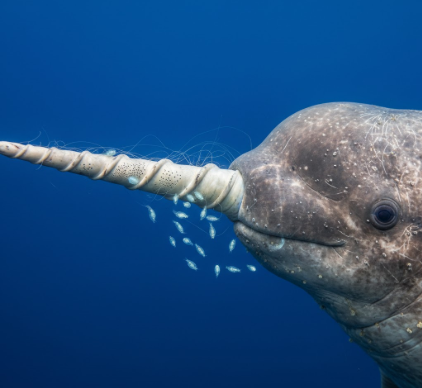
I used to think narwhals were basically unicorns that got lost at sea.
Turns out, that spiraled tusk jutting from their heads—sometimes reaching ten feet long, which is frankly absurd when you consider the animal itself is only around fifteen feet—isn’t there for jousting or impressing potential mates, though I guess that’s a bonus. It’s a sensory organ. A tooth, technically, but one packed with roughly ten million nerve endings that snake from the pulp cavity all the way to the surface, making it one of the most sensitive structures in the marine world. Scientists didn’t really figure this out until the early 2000s, when a team led by Martin Nweeia from Harvard started poking around—literally—at narwhal tusks. They drilled into them, which sounds horrifying, and discovered that the tusk could detect changes in water temperature, salinity, and pressure. Imagine having a ten-foot nerve sticking out of your face. Honestly, it sounds like a nightmare, but for narwhals navigating the murky, ice-choked waters of the Arctic, it’s apparently essential.
Here’s the thing: only males grow these tusks, mostly. Occasionally a female will sprout one, or a male will grow two, because nature loves exceptions. But the sensory function doesn’t change.
The tusk spirals counterclockwise as it grows, bursting through the upper left lip in a way that makes me wince just thinking about it. Inside, those millions of nerve pathways create a direct line to the narwhal’s brain, feeding it constant data about its environment. When researchers observed narwhals in Baffin Bay, they noticed the animals would rub their tusks together—a behavior called “tusking”—and also wave them around near the surface, possibly sampling the water for information about prey concentrations or ice conditions. Wait—maybe that’s why they spend so much time in areas where Arctic cod congregate, because they can literally taste the chemical signatures in the water. It’s like having a biological submarine sonar mixed with a chemical detector, except it’s a tooth.
The Evolutionary Weirdness of Turning a Tooth Into a Sensor
Nobody’s entirely sure why narwhals evolved this way.
The leading theory is that it helped them adapt to one of the planet’s harshest environments, where visual cues are limited and ice cover makes echolocation tricky. Other toothed whales—belugas, dolphins, orcas—they’ve got rows of teeth for grabbing prey. Narwhals have two teeth total, and one of them decided to become a sensory antenna instead. That’s definately an evolutionary gamble. But it paid off, apparently, because narwhals have been around for roughly 50,000 years, give or take, thriving in waters where most creatures would freeze or starve. The tusk’s porosity is key: tiny tubules run through the dentin, connecting the external environment to those internal nerves. When water temperature drops or salinity shifts, the tusk responds almost instantly, sending signals that help the narwhal decide where to dive, when to surface, whether to stay or swim away from encroaching ice.
I guess it makes sense when you think about survival.
Anyway, there’s also the theory that tusks help narwhals stun fish, though the evidence is pretty thin. In 2017, drone footage captured narwhals whacking Arctic cod with their tusks, which looked dramatic but didn’t really prove much. Some scientists think the sensory function is primary and the whacking is secondary—opportunistic, maybe, or just playful. Others argue the opposite, that the tusk evolved for hunting and the sensory stuff is a side effect. Honestly, it’s probably both, because evolution doesn’t follow clean narratives. What we do know is that the tusk’s architecture—hollow, innervated, constantly growing—makes it unlike any other structure in the animal kingdom. It’s not a horn, not a weapon in the traditional sense, not decorative. It’s a living, breathing data collector, and that’s weirdly beautiful in a way that makes me reconsider what I thought I knew about teeth and what bodies can become when pushed by necessity and time and cold black water that never stops moving.
What Happens When the Ice Disappears and the Sensors Stop Working as Well
Climate change is messing with all of this, predictably.
As Arctic ice melts and water temperatures rise, the environmental gradients that narwhals rely on are shifting. Their tusks still work, but the data they’re recieving is different—less reliable, maybe, or harder to interpret. Researchers have documented narwhals spending more time in deeper waters, possibly because surface conditions are too chaotic now. Ship traffic is increasing in areas that used to be frozen year-round, adding noise pollution that interferes with echolocation and, possibly, tusk-based sensing. There’s also the issue of prey distribution: if Arctic cod populations move or collapse, narwhals lose a primary food source, and all that sensory sophistication becomes less useful. It’s frustrating to watch an animal so exquisitely adapted to a specific environment suddenly face conditions it never evolved to handle, and I don’t know what the long-term outcome looks like, but it probably isn’t great.