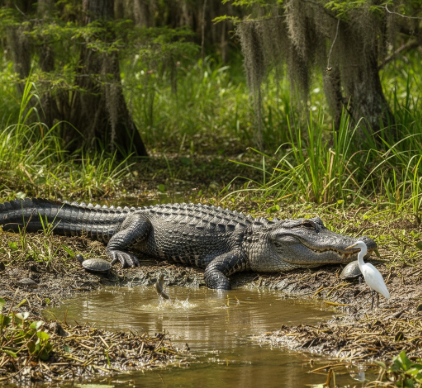
I used to think alligators were just oversized reptiles lounging in swamps, waiting to bite tourists who got too close.
Turns out, these ancient predators—survivors of roughly 37 million years of evolutionary tinkering, give or take—are ecological architects that literally reshape entire wetland landscapes. When alligators dig what biologists call “gator holes” during dry seasons, they’re creating refuges that dozens of other species depend on for survival. Fish, turtles, wading birds, even otters cluster around these water-filled depressions when everything else dries up. The holes act like neighborhood wells in a drought, and without them, whole communities of animals would just… disappear. It’s exhausting to think about how fragile these networks are, honestly. One keystone species vanishes, and the entire structure collapses like a badly stacked Jenga tower.
Here’s the thing: alligators also control prey populations in ways that ripple outward through the food web. They eat raccoons, nutria, and feral hogs—animals that would otherwise devour bird eggs and destabilize nesting colonies. Wait—maybe that sounds overly tidy, but I’ve read studies from the Everglades showing that when alligator numbers drop, mid-sized predator populations explode, and suddenly wading bird colonies crash.
The Architect Predator: How Gator Holes Transform Wetland Survival Dynamics
During Florida’s dry season, which can stretch for months, alligators use their snouts and tails to excavate depressions in the marsh substrate that fill with groundwater. These aren’t casual digs—they’re engineering projects that can reach ten feet across and several feet deep. The holes become micro-ecosystems: algae blooms feed insects, insects feed fish, fish feed herons and egrets. I guess it makes sense when you think about it, but the scale is staggering. One study in the Everglades tracked over 200 vertebrate species using gator holes during peak dry periods. Without those refuges, local extinction events would spike catastrophically.
Anyway, the vegetation around these holes changes too.
Alligators trample plants, create open-water spaces, and their waste fertilizes the surrounding soil with nitrogen and phosphorus. This nutrient dumping—gross as it sounds—fuels plant growth that attracts herbivores, which attract more predators, and suddenly you’ve got this entire trophic cascade spinning out from one reptile’s bathroom habits. It’s messy, unplanned, and definately not something alligators are consciously orchestrating, but that’s how keystone species work. They don’t need intentions; they just need to exist and do their thing.
Trophic Cascades and the Invisible Web of Predator-Driven Ecosystem Balance
Remove alligators, and you don’t just lose a predator—you lose the regulator that keeps mid-level predators in check and maintains habitat heterogeneity. In Louisiana wetlands where alligator populations were decimated by hunting in the mid-20th century, researchers documented explosive growth in raccoon and nutria numbers, followed by catastrophic declines in muskrat populations and marsh vegetation. The marsh itself started eroding faster because plant roots weren’t holding soil together anymore. It’s like watching dominoes fall in slow motion, except each domino is an entire species and the table is an ecosystem that took millennia to assemble.
I’ve seen footage of alligators basking on levees, looking almost bored, and it’s hard to reconcile that image with their ecological importance. But that’s the paradox of keystone species: their influence far exceeds their biomass. They’re not the most abundant organisms—fish and invertebrates vastly outnumber them—but they’re the linchpins holding everything together. Honestly, it’s humbling and a little terrifying to realize how much depends on creatures we’ve spent centuries trying to exterminate.