I used to think reptiles were just lazy.
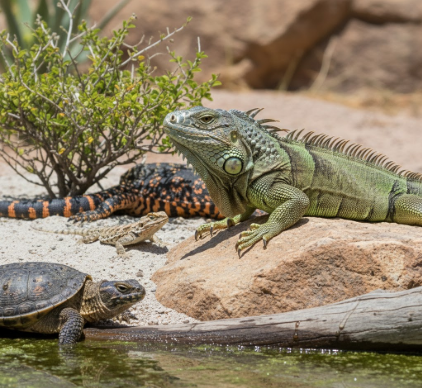
Watching a lizard sprawled on a rock for hours, barely moving except to blink—it seemed like the ultimate in doing nothing. But here’s the thing: that lizard is working. It’s working harder at temperature regulation than I work at, well, most things on a Monday morning. Cold-blooded animals, or ectotherms if we’re being technical about it, don’t generate their own body heat the way we do. They have to borrow it from their environment, which sounds simple until you realize the environment is a fickle, unreliable lender. The sun hides behind clouds. Rocks cool down. Nighttime exists. So reptiles have developed this whole toolkit of strategies—some elegant, some honestly kind of weird—to keep their body temperatures within a workable range. It’s behavioral thermoregulation, and it’s way more sophisticated than I gave it credit for when I was younger and dumber about biology.
The Morning Ritual of Basking and Why It’s Not Just Sunbathing
Most reptiles start their day cold. Like, metabolically sluggish cold.
Their muscles don’t work right, their digestion stalls, they can’t run from predators or chase prey effectively. So the first order of buisness is basking—positioning themselves to absorb solar radiation. But it’s not random. Desert lizards orient their bodies perpendicular to the sun’s rays in early morning to maximize surface area exposure, then gradually shift to parallel positioning as temperatures rise. Some species flatten their ribcages to increase the area available for heat absorption, which I find simultaneously clever and slightly unsettling. Marine iguanas in the Galápagos will actually change color, darkening their skin after emerging from cold ocean water to absorb heat faster. The melanin concentration shifts, and they can warm up roughly 30% quicker than if they stayed their normal grayish-green. Turns out color isn’t just aesthetic—it’s functional, and reptiles have been exploiting this for something like 300 million years, give or take.
Microhabitat Selection and the Art of Finding the Goldilocks Zone
Wait—maybe basking sounds too passive. Because reptiles are constantly making choices.
They’re moving between sun and shade, between hot rocks and cool burrows, between exposed ridges and sheltered valleys. This is microhabitat selection, and it requires a kind of spatial awareness that I definately underestimated before I started reading the research. A study on fence lizards showed they could maintain body temperatures within a 2-3 degree Celsius range across wildly varying ambient temperatures by shuttling between microhabitats every few minutes. They’re not thermostat-controlled, but they’re thermally strategic. Some snakes will coil tightly to reduce surface area and conserve heat, or sprawl out to dissipate excess warmth. Crocodilians bask with their mouths open—a behavior called gaping—which allows evaporative cooling from the mouth and throat tissues. It looks ridiculous, honestly, like they’re perpetually yawning at the world’s longest meeting, but it works. The mucous membranes are highly vascularized, so heat dumps into the environment pretty efficiently.
Behavioral Thermoregulation Gets Weird When You Look at Nocturnal and Fossorial Species
Nocturnal reptiles face a different problem entirely.
The sun isn’t available, so they rely on thermal inertia—the retained heat in rocks, soil, and pavement that absorbed solar radiation during the day. I’ve seen geckos pressed flat against still-warm concrete hours after sunset, extracting every available calorie of heat. Some desert snakes hunt during twilight specifically because that’s when surface temperatures hit the sweet spot between dangerously hot and uselessly cold. Fossorial species—the burrowers—use soil temperature gradients. They dig down when surface temperatures spike, dig up when they need warmth. The thermal conductivity of soil varies with moisture content, depth, and composition, so there’s this whole three-dimensional chess game happening underground that we surface-dwellers rarely think about. A study on horned lizards found they could predict soil temperatures at different depths and would pre-emptively move to optimal zones before surface conditions became intolerable. That’s not instinct—that’s thermal forecasting.
Group Thermoregulation and the Social Side of Temperature Management Strategies
Some reptiles cheat by clustering.
Garter snakes in Canada form massive hibernation aggregations—thousands of individuals packed into underground dens—which reduces individual heat loss through sheer thermal mass. Baby crocodiles pile on top of their mother’s back to stay warm during cool nights. Even some lizard species that are otherwise solitary will huddle during temperature extremes, which suggests the thermal benefit outweighs the usual costs of crowding like increased parasite transmission or competition. There’s also evidence that some reptiles use conductive heat transfer from other animals—sitting on a warm mammal burrow, for instance, or basking near large herbivores that radiate heat. It’s opportunistic thermal piggybacking, and I guess it makes sense from an efficiency standpoint. Why generate heat yourself when someone else already did the work? The trade-off, of course, is that you’re tethering your physiology to external factors you can’t control. When temperatures drop too far or rise too high, ectotherms hit their limits fast. Climate change is already pushing some species toward those limits, compressing the daily and seasonal windows when they can be active. But that’s a different, more exhausting topic.
Anyway, reptiles aren’t lazy. They’re just playing a different game than we are.