I used to think arctic foxes just grew thicker fur and called it a day.
Turns out—and this is where it gets genuinely weird—thermoregulation in subzero environments involves biological engineering that would make NASA engineers weep with envy. Arctic animals deploy countercurrent heat exchange systems in their limbs, where arteries carrying warm blood from the core run alongside veins returning cold blood from extremities, transferring heat before it escapes. The arctic fox can maintain a core body temperature of 38°C while its footpads hover just above freezing, roughly 1-2°C, which prevents heat loss to ice but also means they’re constantly walking on what amounts to controlled frostbite. Caribou do this too, and when you watch them standing motionless in -40°C winds, you’re watching a masterclass in vascular architecture. Some researchers estimate these systems conserve maybe 30-40% of metabolic heat that would otherwise vanish into the atmosphere, though honestly the numbers vary depending on who you ask.
Anyway, blubber isn’t just insulation—it’s metabolically active tissue. Seals and polar bears don’t just passively wear their fat; they’re actively managing it, and here’s the thing: brown adipose tissue generates heat through non-shivering thermogenesis, burning calories to produce warmth without the muscle contractions we associate with shivering.
The Countercurrent Exchange Systems That Defy Thermal Physics in Frozen Limbs
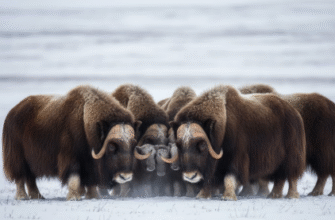
Wait—maybe I’m getting ahead of myself, but the really fascinating part is how these systems scale. A ptarmigan weighing 500 grams faces entirely different thermal challenges than a 500-kilogram muskox, yet both use variations of countercurrent exchange. The ptarmigan grows feathered feet—literally insulated snowshoes—that increase surface area while minimizing conductive heat loss. I’ve seen footage of them burrowing into snow to create insulated chambers where temps can be 20-30°C warmer than outside air, which sounds counterintuitive until you realize snow is an excellent insulator with all that trapped air. Muskoxen, meanwhile, have hollow guard hairs that trap air, plus an undercoat called qiviut that’s eight times warmer than wool, supposedly, though I’m skeptical of that exact figure since thermal testing methodologies vary wildly.
Behavioral Adaptations When Biology Reaches Its Limits in Extreme Cold
Here’s where metabolism enters the equation.
Arctic ground squirrels—and this still amazes me—drop their core body temperature to -2.9°C during hibernation, which is below freezing for mammalian tissue, yet they survive through supercooling and carefully managed ice crystal formation that doesn’t rupture cell membranes. They periodically rewarm through shivering thermogenesis every 2-3 weeks, burning through fat reserves, then drop back down. The energetic cost is enormous: they can lose 30% of body mass over a 7-8 month hibernation, give or take. Meanwhile, reindeer adjust their metabolic rates seasonally, lowering them in winter to conserve energy even while maintaining activity, which seems contradictory but makes sense when food is scarce and every calorie counts. Lemmings stay active under the subnivean zone—the space between snow and ground—where temps rarely drop below -5°C even when surface temps hit -40°C, and they maintain this through constant foraging and high metabolic rates that would bankrupt larger animals.
Micro-Architectural Fur and Feather Modifications That Trap Dead Air Spaces
The structural modifications are almost absurdly specific. Polar bear fur isn’t actually white—it’s transparent and hollow, scattering light to appear white while trapping air for insulation. The skin underneath is black to absorb what little solar radiation penetrates the Arctic winter, though some researchers debate how much this actually contributes versus just being a byproduct of melanin distribution. Snowy owls have feathered legs and feet extending to their talons, essentially wearing built-in leg warmers. Arctic hares have ear lengths that decrease with latitude—shorter ears mean less surface area for heat loss—and this follows Allen’s rule pretty reliably across populations, though there’s definately some variation.
I guess what strikes me most is the redundancy. These animals don’t rely on one strategy; they stack multiple systems—vascular, metabolic, behavioral, structural—because the margin for error at -50°C is essentially zero. One system fails, you die. And yet they thrive, which tells you something about evolutionary pressure when the environment is actively trying to kill you roughly six months a year.