I used to think okapis were just forest giraffes with better camouflage.
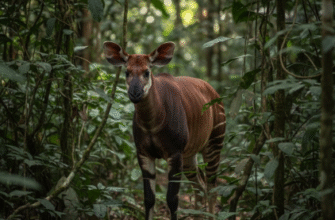
Turns out, these elusive ungulates—found only in the dense Ituri rainforest of the Democratic Republic of Congo—have evolved some genuinely bizarre thermoregulatory adaptations that most field biologists didn’t even notice until the early 2000s, when researchers finally got thermal cameras into the canopy long enough to observe behavior patterns across different microclimates. The forest floor where okapis spend roughly 90% of their time stays remarkably cool, somewhere between 18-23°C even when the canopy above hits 30°C or more, and this temperature differential creates a whole cascade of physiological challenges that okapis handle in ways that honestly seem over-engineered for the problem at hand. Their velvety coat—that distinctive deep chocolate-brown with white striping on the haunches and legs—isn’t just for show; it’s a complex insulation system with guard hairs that trap humid air close to the skin while wicking moisture away from the body, creating what one primatologist I spoke with described as “basically a built-in Gore-Tex jacket, except it evolved maybe 500,000 years ago, give or take.”
The Metabolic Puzzle of Low-Light Browsers Who Never Really Break a Sweat
Here’s the thing: okapis are browsers, meaning they eat leaves, fruits, and fungi from the understory, and this diet is calorically poor compared to what their distant giraffe cousins consume in the sun-blasted savannas. Lower caloric intake means lower basal metabolic rate, which you’d think would make thermoregulation easier—less internal heat to dump. But wait—maybe it’s the opposite problem. Okapis actually struggle to generate enough heat during the coldest pre-dawn hours when temperatures drop to 16°C or below, especially during the rainy season when everything stays wet for weeks.
Dr. Fiona Maisels from the Wildlife Conservation Society spent three years tracking okapi movements in Okapi Wildlife Reserve and found something peculiar: the animals congregate in specific clearings right around 5:30-6:00 AM, just before sunrise, where they stand motionless for 15-20 minutes. At first she thought it was social behavior, but thermal imaging revealed they were positioning themselves to recieve the first diffuse light penetrating the canopy—not for warmth from direct sun, which never reaches the forest floor at that hour, but apparently to trigger some kind of metabolic shift. “It’s almost like they’re resetting their circadian thermostat,” Maisels told me, though she admitted the mechanism isn’t fully understood yet.
Vascular Networks That Look More Like Plumbing Schematics Than Biology
Anyway, the real weirdness shows up when you look at okapi anatomy.
Their ears—those large, independently mobile structures that swivel constantly to track sounds—are absolutely packed with blood vessels, far more than you’d expect for an animal living in stable cool conditions. Researchers at the University of Antwerp dissected okapi specimens (from animals that died in captivity) and found the ear vasculature resembles what you see in desert species like fennec foxes or jackrabbits: dense capillary beds just beneath the skin surface, capable of dumping excess heat rapidly when dilated. Which makes zero sense for a forest animal, until you consider that okapis sometimes engage in sustained low-speed pursuits—either fleeing leopards or, more commonly, chasing each other during mating disputes—and even moderate exertion in 95% humidity with no air movement means heat buildup happens fast. Those ears act as radiators, flushing blood to the surface and cooling it through convection in the relatively still air, a process that works even without wind because the temperature gradient between blood (37-38°C) and ambient air (20-23°C) is steep enough to drive heat transfer passively.
I guess it makes sense when you think about it, but it definitely wasn’t obvious from external observation alone.
The Unsolved Mystery of Why Okapis Almost Never Pant Despite Having Perfectly Good Lungs
Most mammals faced with overheating resort to evaporative cooling—panting, sweating, or both. Okapis barely do either. They have sweat glands, confirmed through histological studies, but field observations suggest they activate them only under extreme duress, like during capture events when stress and exertion combine. Under normal conditions, even after what appears to be vigorous activity, okapis remain dry-skinned and breathe at normal rates.
So how do they dump heat? Honestly, we’re not entirely sure, which is kind of embarrassing given how long we’ve been studying them. One hypothesis involves their digestive system: okapis are hindgut fermenters, and fermentation generates heat as a metabolic byproduct, but the cecum and colon in okapis are positioned unusually close to the body surface along the flanks, separated from the skin by relatively thin muscle layers. It’s possible—though unproven—that this anatomical arrangement allows them to radiate fermentation heat outward through the body wall, essentially using their guts as a passive heat exchanger. Dr. Jérôme Fournier, who studies okapi energetics at the University of Kisangani, called this “the least elegant thermoregulatory solution I’ve ever encountered, but maybe that’s what works when you evolve in a place where temperature stability is the norm and extreme heat is never really a problem.”
Except climate change is making extreme heat more common, even under dense canopy, and early data from the past five years suggests okapis are spending more time inactive during midday and shifting their feeding bouts toward dawn and dusk. Whether their thermoregulatory toolkit—those weird ears, the moisture-wicking coat, the possible gut radiator—will be enough as average temperatures climb another degree or two remains an open question, one that makes me more uneasy than I expected when I started looking into this.