I used to think sea turtles just sort of drifted around, you know, catching jellyfish and looking majestic.
Turns out they’re doing something far stranger—navigating thousands of miles across featureless ocean with a precision that honestly makes our GPS systems look clumsy. Female loggerheads, for instance, will swim from feeding grounds off the coast of Japan all the way back to the exact beach in Florida where they hatched decades earlier. Not just Florida. Not just the same county. The same stretch of sand, give or take a few hundred meters. Scientists have tracked green turtles making 1,400-mile journeys from Brazil to Ascension Island, a speck of volcanic rock barely five miles wide in the middle of the Atlantic. How do they do it? Wait—maybe the better question is why we ever thought they couldn’t.
Here’s the thing: sea turtles appear to have a kind of magnetic map burned into their nervous systems. Hatchlings, barely the size of your palm, emerge from their sandy nests and immediately crawl toward the ocean. Once they hit the water, they start swimming. And swimming. For years, sometimes decades, they’ll circle entire ocean basins—what researchers call the “lost years” because we still don’t entirely know where they go or what they’re doing.
The Earth’s Magnetic Field as a Biological GPS System
The magnetic field isn’t uniform—it varies in both intensity and angle depending on where you are on the planet.
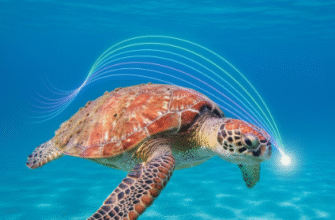
Kenneth Lohmann at the University of North Carolina has spent years demonstrating that turtles can detect these variations. In lab experiments, he exposed hatchling loggerheads to magnetic fields mimicking different locations along their migratory route. The turtles immediately adjusted their swimming direction as if they’d been teleported. They weren’t just sensing north or south—they were reading a complex magnetic signature that told them their precise latitude and longitude. It’s like they’re carrying an invisible map that updates in real time, except it’s not a map they learned. It’s hereditary. Somehow, the magnetic coordinates of their birth beach get encoded into their biology before they even see the ocean.
How Hatchlings Recieve Their Navigational Instructions from Geomagnetic Imprinting
This is where it gets weird. The leading hypothesis is something called geomagnetic imprinting.
When a turtle hatches and makes that frantic dash to the sea, it’s not just fleeing predators—it’s absorbing information. The specific magnetic field at that location, at that moment, becomes a kind of home address. Decades later, when it’s time to nest, the turtle somehow remembers that signature and follows it back. Researchers still don’t fully understand the mechanism—there’s some evidence that magnetite crystals in the turtles’ brains might act as tiny compasses, but the details are frustratingly murky. I guess it makes sense that evolution would favor individuals who could return to successful nesting sites, but the fact that this system works across entire ocean basins, through storms and currents and all the chaos of open water, is kind of staggering.
Environmental Disruptions That Scramble Ancient Navigation Routes
Anyway, there’s a darker side to all this.
Sea turtles have been navigating using Earth’s magnetic field for something like 100 million years, give or take. But now we’re adding our own magnetic noise—underwater cables, offshore wind farms, naval sonar. There’s growing concern that these artificial fields might interfere with turtle navigation, sending them off course. Climate change is shifting ocean currents, which turtles also use as guideposts. Coastal development means the beaches where they need to nest are disappearing or blocked by seawalls and lights that confuse hatchlings. One study found that artificial lighting causes hatchlings to crawl inland instead of toward the ocean, essentially scrambling their imprinting process before it even starts.
Why Some Turtles Still Get Hopelessly Lost Despite Perfect Internal Maps
Not every turtle makes it back. Some get caught in currents they can’t escape.
Others end up in entirely the wrong hemisphere—loggerheads from Japan occasionally wash up in California, thousands of miles off course. Scientists aren’t sure if these are navigational failures, injuries, or just bad luck. There’s also the question of how turtles adjust when the magnetic field itself shifts over time, which it does. The north magnetic pole, for instance, has been drifting toward Siberia at about 30 miles per year. Do turtles update their maps? Do they pass down corrections to the next generation? We don’t definately know. What we do know is that their system, as ancient and elegant as it is, wasn’t designed for the kind of rapid environmental change we’re throwing at it.
The Unanswered Mystery of Multi-Generational Memory Across Turtle Lineages
Honestly, the part that keeps me up at night is the inheritance question. If a turtle’s magnetic map is innate, how does the information get passed down? Is it genetic? Epigenetic? Something else entirely? There are hints that mothers might somehow encode environmental information into their eggs, but the research is still early. And if turtles can inherit a map of a place they’ve never been, what else might be encoded in there? The routes themselves seem to shift slightly over generations, suggesting some kind of adaptive update mechanism. But turtles don’t teach their young—hatchlings are on their own from the moment they emerge. So the entire navigational database has to be pre-loaded somehow, which is both beautiful and deeply strange when you think about it too hard.