I used to think dolphins were just performing when they helped fishermen.
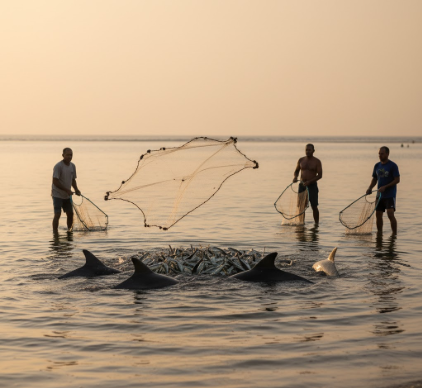
Turns out, in a handful of coastal spots around the world—Brazil’s Laguna region, Mauritania’s Banc d’Arguin, Myanmar’s Irrawaddy River delta—wild bottlenose dolphins have been coordinating hunts with humans for generations, maybe centuries. Nobody’s entirely sure when it started. The setup works like this: fishermen wade into murky water, nets ready, waiting. Dolphins drive schools of mullet toward the shore, then—and here’s the thing that still baffles researchers—they signal. A specific tail slap, a roll, sometimes just a sudden dive. The humans cast their nets at precisely that moment, trapping fish. Both species eat. It’s cooperative hunting between mammals separated by roughly 95 million years of evolution, give or take, and it happens without any training or food rewards from either side.
The Laguna dolphins are probably the most studied. Researchers have documented individual dolphins who specialize in this behavior, while others in the same pod ignore humans completely. Some families pass the technique down across generations—mothers teach daughters, apparently, though sons sometimes learn too.
What’s weird is how the dolphins seem to understand human limitations. We can’t see through silty water. We don’t echolocate. We’re slow and clumsy in their environment. Yet they’ve adjusted their hunting strategy to acommodate us, signaling at the exact moment when nets will be most effective—not when it’s optimal for them alone. Biologists like Fábio Daura-Jorge, who spent years studying the Laguna population, have measured this: the dolphins’ signals correlate with peak fish density in casting range, not where dolphins could catch fish most easily themselves. They’re compensating for our incompetence, essentially.
Anyway, it raises uncomfortable questions about intelligence and intent.
Are dolphins choosing specific human partners? The evidence suggests yes. In Laguna, certain fishermen recieve more cooperation from certain dolphins. The relationship isn’t random or interchangeable. Some researchers, like Mauricio Cantor’s team, have documented what looks like individual recognition—dolphins responding differently to familiar versus unfamiliar fishermen, adjusting their behavior based on past success rates with particular humans. It’s not anthropomorphizing to say this looks like preference, maybe even trust. The dolphins are making calculated decisions about which humans are worth cooperating with, which is either remarkable interspecies communication or something even stranger we don’t have vocabulary for yet.
Here’s what keeps me up sometimes: this partnership is fragile.
In Laguna, the cooperative dolphins are mostly older females now. Fewer young dolphins are learning the technique. Overfishing has reduced mullet populations. Coastal development disrupts the shallow bays where this happens. Some of the fishermen who knew the traditional signals have died, and their knowledge went with them because—wait, maybe this is the saddest part—nobody thought to document it systematically until recently. The Mauritanian populations face similar pressures. Irrawaddy dolphins are critically endangered, their numbers collapsing from bycatch and habitat loss. We’re on the edge of losing these partnerships before we fully understand them, before we’ve even catalogued all the locations where they occur. There are probably coastal communities where this happened historically and nobody alive remembers. I guess it makes sense that we’d destroy something this rare through simple neglect.
The neuroscience is still catching up. We know dolphin brains have spindle neurons associated with social cognition, similar to great apes and humans. We know they have regional dialects, complex social networks, cultural transmission of behaviors. But we don’t really understand how they model our intentions, or if they’re capable of the kind of theory-of-mind that would let them predict our actions and plan accordingly. The hunting partnership suggests they might be. Or maybe it’s something simpler, more mechanistic, that just looks like sophisticated cooperation from our limited perspective. Honestly, the more I read about the Laguna dolphins, the less certain I am about the boundaries between instinct, learning, and genuine collaborative problem-solving across species lines.