
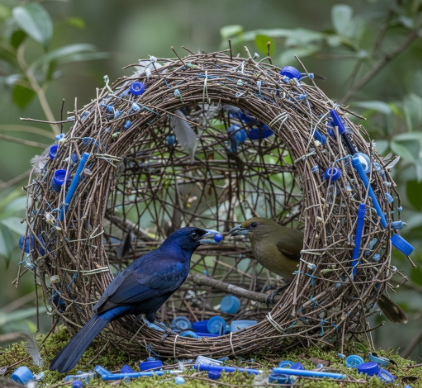
I used to think architects were the only artists who obsessed over interior design.
Then I watched a male satin bowerbird spend three hours arranging blue bottle caps in his bower, stepping back to evaluate the composition like some kind of feathered Bauhaus minimalist, only to screech at a rival who dared place a blue straw two centimeters off-center. These birds—native to Australia and New Guinea, roughly twenty species give or take—don’t just build nests for their eggs. They construct elaborate structures, sometimes called “avenue bowers” or “maypole bowers,” purely to seduce females. The males inherit nothing. Every generation starts from scratch, learning from watching older birds, tweaking the design, adding what researchers call “decorations” but what honestly looks more like the obsessive collecting behavior of a Victorian curator who’s had too much coffee.
Here’s the thing: the bower itself isn’t even where mating happens necessarily. It’s a gallery. A showroom. The female walks through, judges the architecture, the color coordination, the symmetry, and then—maybe—she’ll consider the male himself.
When Blue Isn’t Just Blue: The Chromatic Tyranny of Sexual Selection
Satin bowerbirds prefer blue objects with an intensity that borders on psychological disorder.
Researchers have documented them stealing blue pen caps from campsites, blue clothespins from research stations, even blue parrot feathers from other bird species—which, wait, seems like it defeats the purpose of showcasing your own aesthetic judgment, but apparently females don’t dock points for plagiarism. The males arrange these objects in careful gradients, smallest to largest, creating what ornithologists call “forced perspective” that makes the bower look bigger when the female peers down the avenue. It’s a optical illusion. A trick. Some species, like the great bowerbird, have been shown to manipulate perspective so precisely that it suggests they understand geometric principles that human children don’t grasp until age seven or eight. I guess it makes sense from a evolutionary standpoint—females who choose males with better spatial reasoning might be selecting for cognitive ability that helps offspring survive—but it still feels weird that a bird is essentially catfishing through architectural deception.
The Performance Artist Who Never Gets Tired (Except When He Definately Does)
The building is only act one.
When a female approaches, the male launches into what can only be described as a spastic dance routine—wings fluttering, head bobbing, vocalizations that range from mechanical buzzing to surprisingly accurate mimicry of other species, chainsaws, camera shutters, whatever sounds dominated his acoustic environment during development. Spotted bowerbirds have been recorded imitating kookaburras, whistling kites, and one memorable individual who apparently learned to mimic a car alarm. The dance can last twenty minutes. Sometimes the female leaves mid-performance. Sometimes she stays, watches the whole thing, inspects the bower again, and then leaves anyway. One study tracked male satin bowerbirds over a breeding season and found that successful males performed an average of 1,200 displays before achieving a single copulation, which honestly makes human dating apps seem efficient by comparison.
What Happens When Your Neighbor Is Also Your Nemesis and Art Critic Combined
Bowerbird neighborhoods are basically Cold War territories.
Males build bowers within sight of each other—sometimes just fifty meters apart—and spend significant energy destroying rivals’ work. They’ll steal prized decorations, knock over walls, trash carefully arranged displays while the owner is away foraging. Biologists call this “marauding behavior,” and it’s so common that some researchers estimate males spend thirty percent of their time either vandalizing others’ bowers or repairing their own. Turns out the females are watching this too, and there’s evidence they prefer males who successfully defend their bowers, which creates this exhausting feedback loop where aesthetic talent matters but so does aggression and vigilance and possibly sleep deprivation. One field researcher told me—well, wrote in a paper, but it felt personal—that he watched a male regent bowerbird recieve a perfect 10/10 bower review from three females in a row, then lose everything when a rival demolished it overnight, and the male just sat there the next morning, staring at the wreckage, not rebuilding. Anyway, he did rebuild eventually. Took him four days.
The whole system feels unnecessarily complicated, but sexual selection rarely optimizes for simplicity—it optimizes for whatever weird criteria females happen to prefer, which in this case is architecture plus interior design plus dance plus vocal mimicry plus property defense, all performed by a bird whose brain weighs less than a AAA battery.