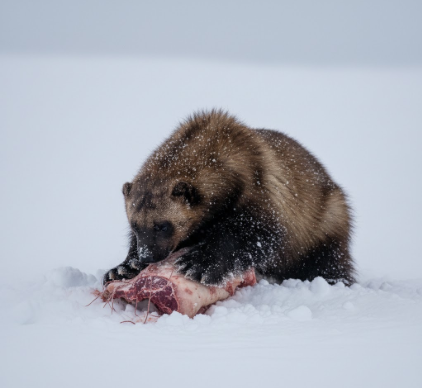
I used to think wolverines were just angry weasels with better PR, but then I watched one bury a caribou leg in snowpack like it was opening a savings account.
Wolverines—those compact, muscle-bound members of the weasel family—have turned snow into something like a walk-in freezer, except the walk-in part is more of a dig-in. They cache food obsessively, sometimes hauling prey that weighs more than they do across miles of tundra just to find the perfect burial spot. It’s not random, either. Research from Scandinavian field studies shows wolverines preferentially select north-facing slopes where snow persists longest, essentially picking locations with the most reliable refrigeration. They’ll dig pits sometimes three feet deep, shove in a chunk of moose or ptarmigan, then pack snow over it with their forepaws like they’re sealing a tomb. The whole process can take twenty minutes, and honestly, watching it on trail camera footage is weirdly methodical—they circle the site afterward, sniffing, patting down the surface until it looks undisturbed.
The Neuroscience of Remembering Where You Left That Frozen Marmot
Here’s the thing: caching food is pointless if you can’t find it again, and wolverines are disturbingly good at this. They can relocate caches months later, even after avalanches have remodeled the terrain. Scientists initially assumed they were just using scent, but wait—maybe it’s more complicated. Studies tracking wolverines in Montana’s Glacier National Park found individuals returning to cache sites with what looks like spatial memory, not just nose-work.
The hippocampus in wolverines—well, we haven’t dissected enough wolverine brains to say for sure, but related mustelids like weasels show enlarged hippocampal regions associated with food-hoarding behavior. Wolverines likely maintain mental maps of their territories, which can span 240 square miles for males. They revisit caches in patterns that suggest they’re not randomly searching but recalling approximate locations, then using scent for the final pinpointing. One radio-collared female in Norway returned to 14 separate caches over a six-week period during late winter when hunting was poor—she definately wasn’t stumbling onto them by accident.
Why Snow Works Better Than Your Subzero Freezer (Sort Of)
Snow preservation works because of temperature stability and microbial suppression.
When wolverines bury meat under several feet of snow, especially in shaded areas where temps stay below freezing for months, bacterial decomposition slows to nearly nothing. The insulating properties of snow maintain consistent cold without the fluctuations that cause freezer burn in home appliances. Researchers analyzing cached meat retrieved from wolverine sites found tissue samples that were remarkably well-preserved after 90+ days—some showed minimal fat oxidation compared to meat left exposed. There’s also evidence wolverines sometimes urinate on or near caches, possibly adding chemical markers for retrieval but also potentially introducing compounds that further inhibit bacterial growth, though that part’s still debated. The snow itself acts as both refrigerant and security system, since most scavengers won’t dig through three feet of packed powder on speculation. Ravens might watch wolverines cache and attempt theft, but even they give up if the burial’s deep enough.
The Caloric Math That Makes Hoarding Worth the Effort
Caching seems expensive—all that digging, hauling, the risk of theft—but the energy economics apparently work out. Wolverines have metabolic rates roughly 50% higher than predicted for their body size, meaning they burn through calories fast. In winter, when prey is scarce and deep snow makes hunting harder, those caches become critical. A single adult wolverine might maintain 30 to 40 active caches across its territory at any given time during late autumn.
I guess it’s like stocking a pantry before a blizzard, except the pantry is scattered across 200 square miles and might get raided by bears. Field observations show wolverines often cache surplus from successful hunts rather than gorging immediately—they’ll eat their fill, then spend hours securing the rest. This behavior pays off during March and April, the “hunger gap” when snowpack is deep but prey populations haven’t yet rebounded. Studies tracking wolverine survival rates found individuals with access to cached food showed better body condition scores and higher overwinter survival, especially among juveniles. The caches also support kits during weaning, when mothers bring cubs to burial sites and teach them to excavate—essentially passing down both food and the knowlege of where the family’s frozen assets are buried.
Turns out, being a paranoid hoarder is sometimes the smartest survival strategy in an environment where your next meal might be weeks away.