I used to think sea turtles just sort of wandered back to their birthplace by accident, maybe following some vague coastal landmark or the smell of seaweed.
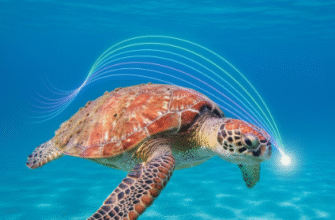
Turns out, loggerhead turtles—those ancient mariners who can weigh up to 350 pounds and live for decades—possess what might be the most sophisticated biological GPS system on Earth. They navigate thousands of miles across featureless ocean to return to the exact stretch of beach where they hatched, sometimes 30 years earlier. And the secret? They’re reading Earth’s magnetic field like a detailed map, sensing infinitesimal variations in magnetic intensity and inclination that shift every few miles along the coast. Kenneth Lohmann, a biologist at the University of North Carolina, spent years proving this by exposing hatchlings to artificial magnetic fields that mimicked locations hundreds of miles away—and watching the tiny turtles immediately swim in directions that would’ve been correct for those phantom locations. It’s not just compass navigation; it’s positional awareness encoded in magnetite crystals embedded somewhere in their nervous system, probably near the trigeminal nerve.
Wait—maybe that sounds too clean. The reality is messier.
The Magnetic Map Isn’t Actually a Map at All, More Like a Patchwork Quilt of Invisible Landmarks
Here’s the thing: Earth’s magnetic field isn’t uniform. Magnetic inclination—the angle at which field lines intersect the planet’s surface—varies predictably as you move north or south. Intensity fluctuates too, especially near geological anomalies. For a loggerhead hatchling leaving a Florida beach, the combination of these two parameters creates a unique magnetic “signature” for that location. Twenty years later, when she’s ready to nest, she follows a mental flowchart: swim until the magnetic intensity reads roughly 48,000 nanoteslas and the inclination hits about 58 degrees, give or take. Researchers discovered this by displacing turtles hundreds of kilometers and tracking their corrective swimming—they didn’t panic, they recalculated. Honestly, I find it exhausting just thinking about the cognitive load. Imagine navigating by sensing invisible forces while dodging fishing nets and eating jellyfish that may or may not be plastic bags.
But there’s a wrinkle. Magnetic fields drift over time—slowly, but measurably. The signature of a beach in 1995 isn’t identical to 2025.
Why Some Turtles Definately Mess Up and End Up Nesting on the Wrong Beach Entirely
Not every turtle nails the landing. Studies along the southeastern U.S. coast show about 15-20% of nesting females end up on beaches within a 50-kilometer radius of their birth site, not the exact spot. Whether that’s magnetic field drift, geomagnetic storms scrambling the signal, or just individual variation in sensitivity—nobody’s entirely sure. Nathan Putman, who worked with Lohmann, ran simulations showing that if a turtle’s internal map is even slightly outdated, she could miss her target by dozens of miles. There’s also evidence that older females are better navigators than first-time nesters, which makes sense: practice refines the skill, or maybe survivors of multiple migrations are simply the ones with superior magnetoreception to begin with. I guess it’s a bit like how some people can’t find their car in a parking lot even with landmarks, while others navigate cities without GPS. Genetic lottery meets experience.
Anyway, the implications go beyond turtles.
Magnetic Navigation Could Explain Why Salmon, Lobsters, and Even Some Birds Don’t Need Google Maps Either
Loggerheads aren’t alone in this. Sockeye salmon return to natal streams using geomagnetic cues learned as juveniles. Spiny lobsters orient using magnetic fields during migrations. Even pigeons—those urban scavengers we barely notice—have magnetite in their beaks and use field lines for homing. The difference is turtles do it across entire ocean basins, over decades, with no visual cues. When you think about it, humans had to invent sextants, chronometers, and eventually satellites to achieve what a turtle does with microscopic iron crystals and a brain the size of a walnut. Roger Brothers, a geophysicist who collaborated on turtle tracking studies, noted that if we could reverse-engineer this system, we’d have navigation tech that never needs batteries, recalibration, or software updates. But extracting the mechanism is maddeningly difficult—cutting open a turtle’s brain to find magnetoreceptors is like looking for a specific neuron in a haystack while the haystack is swimming away from you.
The whole thing makes me wonder what else we’re missing about animal perception. Maybe turtles experience the world in a way so alien to us—magnetic gradients rendered as colors, or textures, or something we don’t even have words for—that calling it “navigation” undersells the phenomenon. They’re not following a map. They’re reading the planet itself.