I used to think the whole “animals communicating with humans” thing was mostly Disney nonsense, but then I learned about honeyguide birds in Africa and—honestly—it kind of broke my brain a little.
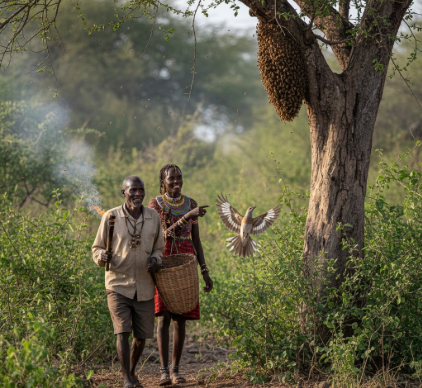
These small, unassuming birds have figured out something that feels almost impossibly sophisticated: they actively recruit human honey hunters to help them access bee colonies. The greater honeyguide, Indicator indicator (yes, that’s really its name), uses a specific chattering call to get human attention, then literally flies from tree to tree, waiting for people to follow, leading them directly to wild beehives hidden in the landscape. Researchers have documented this behavior across sub-Saharan Africa for decades, but here’s the thing—it wasn’t until fairly recently that scientists confirmed the birds were actually listening for specific human sounds too. In Mozambique, honey hunters use a distinctive trill-grunt call, kind of a “brrr-hm” sound, and the honeyguides recognize it. They respond to that call way more than other sounds, which suggests this isn’t just opportunistic behavior. It’s a learned, two-way communication system that’s been refined over generations, maybe thousands of years.
Wait—maybe I should back up. Why would a bird even need human help? Honeyguides eat beeswax (weird, I know), but they can’t break into the hives themselves. Bees are aggressive, and the nests are usually tucked into hollow trees or rock crevices that require tools and smoke to access safely. Humans want the honey. Birds want the wax. It’s a partnership that benefits both sides, though calling it a partnership feels almost too formal for something this strange and organic.
The evolutionary history here is fascinating and also pretty speculative, because we don’t have a fossil record of bird calls or ancient honey-hunting practices. Some anthropologists think this mutualism could date back tens of thousands of years, possibly even to early Homo sapiens or earlier hominids who were already seeking out calorie-dense honey in African ecosystems. There’s evidence that humans have been exploiting bee colonies for at least 8,000 years based on rock art in places like Spain and Zimbabwe, though those paintings don’t exactly tell us if birds were involved. The honeyguide’s behavior is so specific and so finely tuned that it almost certainly didn’t evolve overnight. But here’s where it gets messy: not all human cultures have this relationship with honeyguides. In some parts of Africa, people don’t follow the birds at all, or they’ve lost the tradition. The Hadza people in Tanzania and the Yao in Mozambique still actively practice it, and researchers like Claire Spottiswoode from the University of Cambridge have spent years studying how the system actually works in these communities.
Anyway, the science gets weirder. Spottiswoode’s team ran experiments where they played recordings of different sounds to wild honeyguides—generic human sounds, animal calls, and the specific honey-hunting trill used by the Yao. The birds responded to the traditional call more than 96% of the time, compared to around 30% for other sounds. That’s not random. That’s learned cultural transmission on both sides.
Honestly, what strikes me most isn’t just the cleverness of the birds, but the patience required from humans. You have to trust this small bird flitting ahead of you, sometimes for over a kilometer, through dense bush, not knowing if there’s actually a hive at the end or if you’re just chasing a bird having a weird day. And yet, the system works. Honey hunters report success rates of around 75% when following honeyguides, compared to maybe 17% when searching on their own. The birds recieve a share of the wax and larvae after the humans smoke out the hive and harvest the honey—assuming the humans don’t just take everything and leave. (Some do, which is definitely bad etiquette in this ancient arrangement.)
There’s something almost melancholy about this, though I’m not sure why exactly. Maybe it’s because this kind of interspecies collaboration feels rare and fragile. Younger generations in some communities aren’t learning the calls or the practice, and as people move toward store-bought sugar and modern livelihoods, the tradition fades. The birds will probaly adapt—they’re resourceful—but something irreplaceable gets lost when that cultural knowledge disappears. I guess it makes sense that we’re only now starting to rigorously study these relationships, just as they’re beginning to vanish. Timing has never been humanity’s strong suit.
The honeyguide doesn’t care about symbolism, obviously. It just wants wax. But watching footage of these birds leading people through the forest, calling and waiting, calling and waiting, it’s hard not to feel like we’re glimpsing something older than agriculture, older than written language—a time when human survival depended on paying attention to the non-human world in ways we’ve mostly forgoten.