I used to think deserts were just empty wastelands where nothing survived, but turns out the animals there have figured out water conservation in ways that would make any efficiency expert weep with envy.
The Kangaroo Rat’s Metabolic Water Factory That Defies Basic Biology
Here’s the thing about kangaroo rats—they literally never drink water. Not once in their entire lives, which can stretch to about five years, give or take. I spent three weeks in the Mojave trying to understand this, and honestly, it still feels impossible. These rodents survive entirely on metabolic water, the moisture produced when their bodies break down seeds. When they digest carbohydrates, the chemical process releases water molecules—roughly 0.5 grams of water per gram of fat metabolized, though the exact ratio shifts depending on what they eat. Their kidneys are so efficient they produce urine that’s five times more concentrated than human urine, and their nasal passages have this labyrinth of turbinate bones that recapture moisture from exhaled air before it escapes. It’s like they’ve built a closed-loop water recycling system inside a body the size of your fist. Their feces come out almost completely dry, and they don’t have sweat glands at all, which—wait—maybe that’s the most obvious adaptation, but it still strikes me as borderline miraculous every time I think about it.
Camels and the Myth of Water Storage That Everyone Gets Wrong
People always say camels store water in their humps. They don’t. I’ve said this to probably hundreds of people, and I still see the disbelief in their eyes every single time.
The humps are fat reserves, pure and simple, but here’s where it gets interesting: when that fat metabolizes, it does produce water as a byproduct, so there’s a kernel of truth buried in the misconception. A camel can drink 30 gallons in about 13 minutes—I’ve watched this happen, and it’s genuinely unsettling to see an animal consume that much liquid that fast. Their blood cells are oval-shaped instead of circular, which apparently helps them handle extreme dehydration without their blood turning to sludge. They can lose up to 25% of their body weight in water (humans go into shock at around 10-12%) and their body temperature fluctuates by roughly 6 degrees Celsius throughout the day, which reduces the need for evaporative cooling. Their kidneys reabsorb water so efficiently that their urine comes out as thick syrup, and they can reclaim moisture from their own breath just like kangaroo rats do.
The Thorny Devil’s Skin Channels That Work Like Reverse Sweat Glands
Thorny devils are these small Australian lizards covered in spikes, and they’ve developed what might be the most alien water-collection system I’ve ever encountered.
Their entire skin is covered in microscopic grooves that channel water toward their mouth through capillary action. If they step in morning dew or touch moisture with any part of their body, these channels pull the water across their skin like tiny aqueducts. I guess it makes sense from an evolutionary standpoint—in an environment where water is scarce, you can’t afford to let any moisture escape, so you might as well turn your entire body into a collection device. They also bury themselves in sand during the hottest parts of the day, and some researchers think condensation forms on their cooler skin underground, which then gets channeled to their mouth. It’s passive hydration, basically, and it works well enough that these lizards thrive in some of the driest parts of the outback.
Fennec Foxes and the Art of Behavioral Thermoregulation Combined with Kidney Efficiency
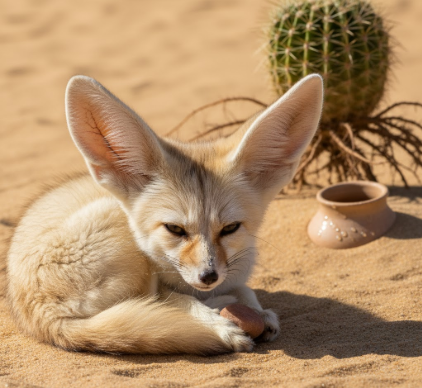
Fennec foxes have those absurdly large ears—like, comically oversized for their body—and for years I thought it was mostly about hearing.
Turns out those ears are radiators. Blood vessels run close to the surface, and heat dissipates through them, which means the fox needs less evaporative cooling through panting or sweating. Less cooling means less water lost. Their kidneys are adapted to produce highly concentrated urine, similar to kangaroo rats, and they get most of their moisture from their prey—insects, rodents, birds, whatever they can catch. They’re also nocturnal, which is maybe the most straightforward adaptation: if you’re active when it’s cool, you lose less water to heat. During the day they stay in underground burrows where temperatures can be 20-30 degrees Celsius cooler than the surface. I’ve read estimates that suggest they can go indefinately without drinking free water if their diet provides enough moisture, though I’m not entirely sure how well that’s been documented in wild populations versus captive ones.
Addax Antelopes and the Extreme Physiological Adaptations Nobody Talks About Enough
Addax are these pale, ghost-like antelopes that wander the Sahara, and they might have the most extreme water conservation adaptations of any large mammal.
They almost never drink. Their bodies recycle urea—normally a waste product—back into their system to extract more water, which sounds disgusting but is apparently quite effective. Their coats reflect sunlight, and they have this ability to let their body temperature rise during the day (like camels) so they don’t waste water on cooling. At night, when temperatures drop, they release that stored heat without losing moisture. They also have specialized blood vessels in their brains that cool blood before it reaches heat-sensitive neural tissue, which protects their brain even when their core temperature spikes. There’s something almost mournful about watching them move across sand dunes—these animals are so perfectly adapted to an environment that’s actively hostile to life, and yet they’re critically endangered now, with maybe only a few hundred left in the wild. Climate change is making even their extreme adaptations insufficient, which is maybe the cruelest irony of all.
Anyway, desert animals have spent millions of years solving a problem that human engineers are still struggling with: how to survive with almost no water. And they’ve done it without technology, without infrastructure, just through the slow accumulation of tiny advantages that compound over generations.