
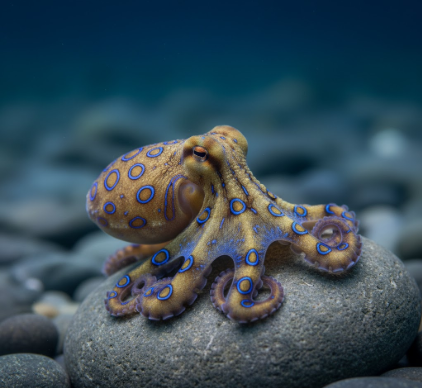
The blue-ringed octopus is about the size of a golf ball.
I used to think venom was something that scaled with size—like, the bigger the animal, the more dangerous it could be. Turns out that’s not how evolution works at all. The blue-ringed octopus, which you could hold in the palm of your hand if you had a death wish, carries enough tetrodotoxin to kill 26 adult humans in a matter of minutes. There’s no antivenom. If you get bit, you’re basically hoping someone nearby knows CPR and can keep you breathing until the paralysis wears off, which could take hours. The octopus itself weighs maybe an ounce, maybe less depending on the species—there are four recognized species in the genus Hapalochlaena, and they all pack the same horrifying punch. It’s one of nature’s most elegant reminders that size means almost nothing when it comes to lethality.
Here’s the thing: the blue-ringed octopus doesn’t even produce its own venom. It farms it. The tetrodotoxin comes from symbiotic bacteria living in the octopus’s salivary glands, bacteria that also show up in pufferfish and some newts. The octopus essentially cultivates these microbes, and in return, it gets access to one of the most potent neurotoxins on Earth. When it bites—usually because someone picked it up, mistaking it for a harmless tidepool curiosity—the venom blocks sodium channels in nerve cells, shutting down the ability to send signals. Muscles stop working. You can’t move, can’t breathe.
Why Something So Small Became So Deadly in the First Place
The evolutionary pressures that led to this are still debated, but the leading theory is pretty straightforward: blue-ringed octopuses are slow, soft-bodied, and live in shallow waters where predators are everywhere. They don’t have shells. They can’t swim fast. They’re basically tiny, squishy targets. So instead of armor or speed, they evolved a nuclear option. The bright blue rings that give them their name only appear when the octopus is threatened—a last-ditch warning system that says, essentially, “back off or we both lose.” Most predators that ignore that warning don’t get a second chance to learn. The venom works fast, and it works on fish, crabs, and anything else that might consider the octopus a snack. It’s a defensive weapon, not an offensive one, which is why blue-ringed octopuses are generally shy and reclusive. They don’t want to fight. They just want to survive.
I guess it makes sense when you think about it. In the arms race of evolution, sometimes the best strategy isn’t to get bigger—it’s to get more dangerous per gram of body weight. The blue-ringed octopus represents an extreme endpoint of that strategy. A single milligram of tetrodotoxin is enough to kill an adult human, and one octopus can carry up to 25 milligrams. That’s not just overkill; that’s a deterrent so effective that the octopus rarely has to use it. Most animals that encounter one and live to tell the tale—metaphorically speaking—learn to avoid anything with those iridescent blue rings. It’s a warning label written in biology.
The Mechanics of Tetrodotoxin and Why It’s So Uniquely Terrifying
Tetrodotoxin doesn’t destroy tissue or cause pain the way some venoms do. It’s almost polite in its efficiency. You get bitten, and at first, you might not even notice—the bite itself is tiny, sometimes painless. Then, within minutes, you start to feel tingling around your mouth and extremities. Your lips go numb. Your tongue feels thick. And then the paralysis starts creeping in, moving from your limbs toward your chest. Your diaphragm stops working. You’re fully conscious the entire time, trapped inside a body that won’t respond. It’s the kind of thing that sounds like science fiction, but it’s been documented in dozens of cases, mostly in Australia and the Indo-Pacific, where these octopuses are most common. The survival rate is actually pretty good if someone performs rescue breathing—the venom doesn’t damage the heart or brain directly, it just blocks the signals. Wait it out, keep the victim oxygenated, and eventually the toxin metabolizes. But that’s a big if.
Honestly, the blue-ringed octopus feels like nature showing off. It didn’t need to be this dangerous. It could have evolved mildly toxic skin or a bad taste, something to make predators think twice. Instead, it went straight to one of the most lethal substances on the planet, cultivated from bacteria, delivered through a beak the size of a grain of rice. And it works. The octopus lives its life in shallow reefs and tide pools, hunting small crabs and shrimp, mostly unbothered. It’s a masterclass in deterrence. The message is clear: don’t touch.
There’s something almost absurd about the whole setup—a creature the size of a walnut that could, theoreticaly, kill you before you even realized you were in danger. It’s a reminder that in nature, the rules we assume don’t always apply. Venom doesn’t scale with size. Danger doesn’t announce itself with fangs or claws. Sometimes it’s quiet, beautiful, and smaller than your fist.








