I spent three weeks watching beavers in northern Montana, and honestly, I expected to be bored out of my mind.
What I found instead was something closer to witnessing urban planning in real time—except the architects weigh forty pounds, have orange teeth, and work exclusively at night. Beavers don’t just build dams because some ancient rodent instinct tells them to pile sticks in water. They’re reshaping entire watersheds, and they do it with a level of environmental awareness that makes me wonder if we’ve been underestimating them for, I don’t know, the entire span of human history. A single beaver family—usually six to eight individuals—can flood several acres of forest in a matter of weeks, creating ponds that didn’t exist before. These aren’t random puddles. They’re engineered wetlands that trap sediment, filter pollutants, recharge groundwater, and create habitat for dozens of species that otherwise wouldn’t survive in fast-moving streams.
The thing is, beaver dams aren’t permanent structures. They leak, they break, they require constant maintenance. And yet the beavers keep at it, sometimes for generations, rebuilding the same dam over and over until the landscape itself changes.
When a Dam Goes Up, the Whole Neighborhood Changes—And I Mean Everything
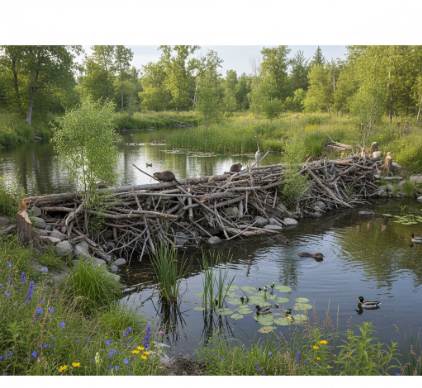
Here’s what actually happens when beavers move into a stream. First, they gnaw down aspens, willows, cottonwoods—whatever’s within roughly fifty meters of the water. They drag the branches into the current and wedge them between rocks or tree stumps, building a lattice framework. Then comes the mud, grass, leaves, and more sticks, packed in until the structure is dense enough to slow the flow. Within days, water starts pooling upstream. Within weeks, you’ve got a pond. And that’s when things get weird.
The flooded zone kills some trees—usually conifers that can’t handle wet roots—but it also creates standing deadwood, which woodpeckers love. The pond itself becomes a nursery for amphibians, insects, fish fry. Moose show up to browse on aquatic plants. Otters move in because the slower water is easier to hunt in. Ducks nest in the reeds that sprout along the pond’s edges. I’ve seen great blue herons, mink, and even the occasional bear show up to recieve the benefits of a beaver’s work, though the beavers themselves are usually hidden by then, probably sleeping in their lodge.
Wait—maybe the most surprising part is what happens downstream.
Because the dam traps sediment, the water that eventually spills over or seeps through is cleaner than it was before. During droughts, beaver ponds release stored water gradually, keeping streams flowing when they’d otherwise dry up. During floods, the ponds absorb excess runoff, reducing erosion and preventing catastrophic washouts downstream. Researchers in California and Oregon have started calling beavers “nature’s firefighters” because their ponds create green, wet firebreaks in otherwise dry landscapes. In some areas, beaver-engineered wetlands have measurably lowered wildfire intensity. I used to think that was an exaggeration until I saw the satellite data myself.
Turns Out, We Spent Centuries Trying to Get Rid of the One Animal That Could Help Us Adapt to Climate Change
The irony is almost too much.
North America once had somewhere between 60 and 400 million beavers—the range is huge because nobody was counting back then, and honestly, estimates vary wildly depending on who you ask. By 1900, after centuries of fur trapping, that number had dropped to maybe 100,000. We nearly exterminated them. And now, as droughts intensify and water tables drop and wildfires rage across the West, ecologists are literally reintroducing beavers to places they used to live, hoping they’ll do what they’ve always done: build dams, store water, cool streams, create habitat. There’s a term for this—”beaver-based restoration”—and it’s cheaper, faster, and often more effective than human-engineered solutions.
Some ranchers still hate them, obviously. Flooded pastures, culverts blocked, roads washed out—beavers don’t care about property lines. But in places where people have learned to coexist with them, the results are striking. Stream temperatures drop by several degrees Celsius in beaver ponds, which is critical for cold-water fish like salmon and trout. Native plant diversity increases. Groundwater recharge improves, which means wells don’t run dry as quickly during droughts.
I guess what strikes me most is how much beavers accomplish without any central planning, without blueprints, without meetings or permits or environmental impact statements. They just… do it. And in doing so, they create ecosystems that are more resilient, more biodiverse, and more capable of weathering the climate chaos we’ve unleashed. It’s humbling, actually. And maybe a little embarrassing that it took us this long to figure out that the rodent we spent centuries trying to kill might be one of the best allies we have in adapting to a hotter, drier, more unpredictable world.