I used to think archerfish were just showing off.
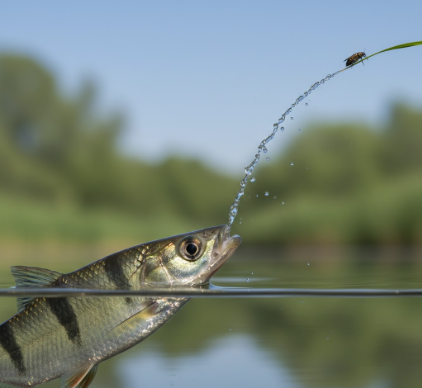
Watching them in an aquarium once, I saw this silver streak hover below the surface, eye a beetle on a leaf maybe two feet above the water, and—pfft—nail it with a jet stream that looked like it came from a tiny hydraulic cannon. The bug dropped. The fish ate. And I remember thinking, okay, that’s neat, but surely it’s just practice, right? Like throwing darts until you get good. Turns out—and this is where it gets weird—archerfish aren’t just memorizing angles. They’re doing something closer to real-time physics calculations, compensating for refraction, distance, and the arc of a projectile that starts to break apart mid-flight. And they do this without a prefrontal cortex. Or, you know, hands. Which is either humbling or deeply annoying, depending on how you feel about being outsmarted by a fish that weighs less than a sandwich.
Here’s the thing: the math shouldn’t work. When an archerfish looks up at an insect, it’s seeing that bug through two different media—water and air—which means the light reflecting off the prey bends at the water’s surface. This is refraction, the same reason a straw looks broken in a glass of lemonade. So the bug isn’t actualy where it appears to be. And yet, archerfish hit their targets with roughly 90% accuracy on the first shot, even if they’ve never seen that particular prey item before.
The Ballistics Problem That Shouldn’t Have a Solution (But Does)
Researchers at the University of Bayreuth spent years trying to figure out how this works. They set up high-speed cameras and watched archerfish fire at artificial targets placed at different heights and angles. What they found was unnerving. The fish weren’t just aiming at where the bug appeared. They were adjusting their aim to account for where the bug actually was—correcting for refraction on the fly. Stefan Schuster, one of the lead researchers, described it as the fish solving a problem that would require a human to sit down with trigonometry tables. Except the archerfish does it in under a second, usually while also keeping an eye out for competitors.
Wait—maybe it’s instinct?
That’s what I thought, too. But the experiments got weirder. When researchers moved the targets to positions the fish had never encountered before, the archerfish still adjusted correctly. They weren’t relying on pre-programmed angles. They were—somehow—calculating trajectory in real time, factoring in both the refraction issue and the fact that their water jet loses coherence the farther it travels. The jet stream starts as a tight column but breaks into droplets after about 15 centimeters, which means the fish has to account for projectile decay, too. It’s like trying to hit a moving target with a squirt gun that turns into a mist halfway through, except you’re also looking at the target through a funhouse mirror.
Vision, Timing, and the Mouth Cannon No One Asked For
The mechanics are absurd. An archerfish fires by pressing its tongue against a groove in the roof of its mouth, forming a tube, then snapping its gills shut to force water through at high pressure. The whole thing takes about 50 milliseconds. And because the fish is underwater, it has to compensate for the drag and buoyancy of its own body while aiming upward at an angle that changes depending on how far away the prey is. Honestly, it’s exhausting just thinking about it.
What makes it even stranger is that archerfish seem to learn from watching each other. Juvenile fish improve faster when they’re housed with experienced adults, which suggests there’s some kind of social learning going on—though calling it “teaching” might be a stretch, since the adults don’t seem to care whether the kids are paying attention. It’s more like: watch me nail this cricket, figure it out yourself, good luck.
The Neural Mystery Behind the Wet Sniper Routine
Here’s where we hit the edge of what we actually know. Despite decades of research, no one has definitively pinned down which part of the archerfish brain is handling these calculations. We know they’ve got excellent vision—two large eyes that can swivel independently, giving them a wide field of view even while submerged. We know their retinas are packed with cone cells, which help with color and detail. But the processing of all that visual data, plus the refraction correction, plus the trajectory adjustment? That’s still mostly a black box. Some researchers think it’s happening in the optic tectum, a brain region involved in visual processing and motor control. Others suspect it’s distributed across multiple areas, a kind of neural teamwork that we don’t fully understand yet. Either way, it’s remarkable that a brain the size of a pea can pull off what looks like applied physics, while I still sometimes miss the trash can when tossing a wadded-up receipt from three feet away. I guess it makes sense, evolutionarily—miss your shot in the wild, and you don’t eat. But still. The bar feels unfairly high.