I used to think cacti were just, you know, spiky plants that happened to live in deserts.
Turns out the relationship between cacti and desert wildlife is this sprawling, messy co-evolutionary dance that’s been going on for something like 20 million years, give or take a few million. The spines we associate with cacti—those needle-sharp defenses—aren’t just random armor. They’re incredibly specific adaptations shaped by everything from pack rats to peccaries, from hummingbirds to hawk moths. Some cacti, like the teddy bear cholla, have spines so barbed they’re almost sentient in how they latch onto passing animals, hitching rides to new territories. Others, like certain barrel cacti, have developed spines that curve inward, creating shaded pockets that actually trap morning dew, which then trickles down to the roots—a design so elegant it feels almost intentional, though of course it’s just thousands of generations of trial and error.
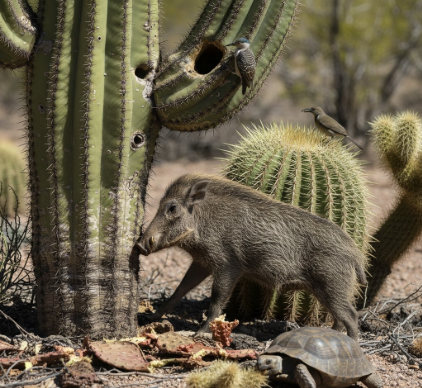
Here’s the thing: not all spines are about defense. The saguaro cactus, that iconic symbol of the American Southwest, has relatively soft spines compared to smaller species. Why? Because it’s evolved alongside a whole community of creatures that depend on it—Gila woodpeckers excavate nesting cavities in its flesh, which are later used by elf owls, flycatchers, even bats. The cactus doesn’t fight this; it’s developed callused tissue that forms around these wounds, creating little fortified apartments. I’ve seen photographs of a single saguaro hosting, like, five different species at once, and it makes you wonder who’s really in control here.
The Pollinators Who Shaped Everything (And Got Drunk in the Process)
Wait—maybe the most fascinating part is how cacti flowers evolved specifically to match their pollinators’ schedules and, honestly, their vices. Night-blooming cereus cacti open their massive white flowers exclusively after dark, timed precisely for nectar-feeding bats like the lesser long-nosed bat. These bats are messy drinkers, getting pollen caked all over their furry faces as they gorge on nectar that can ferment slightly in the desert heat. Some researchers have documented bats exhibiting what looks suspiciously like intoxicated flying patterns after visiting multiple flowers. Meanwhile, daytime-blooming species like the claret cup cactus have evolved brilliant red tubular flowers—a color most desert insects can’t even percieve properly, but hummingbirds absolutely can. The shape is basically a hummingbird beak template. It’s all so specific it feels almost conspiratorial.
When Protection Becomes Collaboration Instead of Just Spikes and Threats
Then there’s the phenomenon of ant-cactus mutualisms, which I’ll admit I find kind of exhausting to think about because they’re so complex. Certain cacti secrete extrafloral nectar—sweet droplets produced outside the flowers—specifically to attract aggressive ant species. The ants patrol the cactus surface, attacking any herbivorous insects or even small vertebrates that try to munch on the succulent flesh. In return, the ants get a steady food source and sometimes even nesting sites within the cactus itself. One study I read tracked a population of fishhook barrel cacti in Arizona and found that individuals with active ant colonies had roughly 70% less herbivore damage than those without. The cacti essentially employ tiny, vicious bodyguards.
The Seed Dispersal Economy That Nobody Talks About Enough
I guess it makes sense that cacti would need help spreading their seeds in an environment where water is scarce and seedling mortality is brutal, but the strategies are wild. The saguaro’s bright red fruits are timed to ripen exactly when migratory birds and desert-dwelling mammals are most desperate for moisture. Coyotes eat the fruits whole, and the seeds pass through their digestive systems not only intact but actually scarified—their coatings partially dissolved by stomach acids, which improves germination rates. White-winged doves, which can consume dozens of saguaro fruits in a day, have become so dependent on this food source that their entire breeding cycle in the Sonoran Desert is synchronized with cactus fruiting season. The birds get hydration and calories; the cacti get their seeds deposited miles away in neat little fertilized packages.
How Extreme Environments Force Unlikely Partnerships Nobody Would Have Predicted
Anyway, the really strange adaptations emerge in the most extreme desert environments.
In the Atacama Desert, where some areas haven’t recieved measurable rainfall in recorded history, certain cacti have evolved to capture moisture from coastal fog using specialized spine structures that condense water droplets. But even here, they’re not alone—they’ve formed partnerships with darkling beetles that also harvest fog, and the beetles’ burrows around cactus bases actually improve soil aeration, helping roots access what little moisture accumulates. In parts of the Chihuahuan Desert, cacti have been documented growing in the shade of mesquite trees despite being sun-loving plants, apparently because the trees attract rodents whose burrows and waste create nutrient-rich microsites. The cacti tolerate reduced light in exchange for better soil and protection from the most extreme temperature swings. It’s all so interconnected it makes you dizzy, honestly. These aren’t just plants surviving in harsh places—they’re anchor species holding together entire ecological networks, shaped by and shaping the animals around them in feedback loops that have been running since, what, the Miocene epoch? The desert isn’t empty. It’s definately not simple. It’s just selective about who gets to participate.