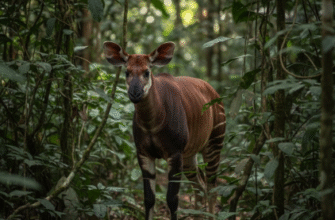
The okapi’s coat looks like someone took a giraffe, a zebra, and a horse, threw them in a blender, and then decided the result should live in one of the most unforgiving places on Earth.
I spent three weeks in the Ituri Forest back in 2019, and I remember thinking the whole time: how does anything this big stay hidden? The okapi—Okapia johnstoni, if you want the Latin—wasn’t even confirmed by Western science until 1901, which is wild when you consider how many Europeans were stomping around the Congo by then. But here’s the thing: these animals are basically evolutionary ninjas. Their reddish-brown coat with those stark white stripes on the legs and hindquarters? That’s not fashion. That’s disruptive coloration, breaking up their body outline in the dappled light filtering through the canopy. When you’re standing in that forest, with shafts of sunlight cutting through at weird angles and shadows everywhere, you start to understand how a 440-pound animal can just… vanish. It’s not magic—it’s physics and biology conspiring together. The stripes probably help calves follow their mothers too, though honestly, watching them move through undergrowth, I’m not sure they need much help.
Their ears can rotate independently, which sounds like a minor detail until you’re in a place where every sound matters. Leopards. Humans. Other okapis, maybe. The forest is loud and quiet at the same time, if that makes sense—constant noise, but you can’t see what’s making it.
The Tongue That Does Everything Except Make Small Talk
Wait—maybe the weirdest adaptation is that tongue. It’s blue-gray, prehensile, and can reach up to 18 inches long, which is the kind of measurement that makes you do a double-take. Okapis use it to strip leaves from branches, clean their own eyes and ears, and apparently groom their calves. I watched footage once of an okapi basically power-washing its own eyelids with its tongue, and I haven’t been the same since. The tongue is coated in sticky saliva—perfect for grabbing foliage in dense vegetation where precision matters more than speed. They’re browsers, not grazers, feeding on leaves, fruits, fungi, and ferns that grow low in the understory. Turns out the Ituri has over 100 plant species that okapis eat, though they’re picky about timing—some plants are only palatable during certain seasons. Their multi-chambered stomach ferments this roughage efficiently, extracting nutrients from材料 that would give most animals indigestion. And because they’re eating constantly—roughly 45 to 60 pounds of vegetation daily—that tongue never really gets a break.
The solitary lifestyle makes sense when you think about resource distribution. Food in rainforests isn’t evenly spread; it’s patchy, unpredictable. A herd would strip an area bare too quickly.
Navigating in Near-Darkness Without Bumping Into Trees (Mostly)
Okapis have large eyes positioned to give them decent peripheral vision, which helps when you’re trying not to become leopard lunch. But vision only gets you so far in a place where the canopy blocks 95% of sunlight—I’m guessing that number, but it feels right. They rely heavily on scent glands on their feet, leaving chemical trails that mark territory and, probably, help them navigate. Males and females maintain overlapping home ranges of about 2.5 to 5 square kilometers, which doesn’t sound like much until you try walking through that terrain. It’s dense. Vines everywhere, fallen logs, mud that sucks at your boots. Okapis have slightly longer front legs than back legs, giving them a sloped posture that helps them push through thick vegetation without getting stuck. Their body is compact for a giraffid—they’re the only other living member of the giraffe family, by the way—but that compactness is an advantage when you’re threading through a forest that doesn’t want you there. I used to think shorter necks were a disadvantage, but in dense forest, a long neck is just a liability waiting to happen. Okapis can lower their heads to the ground or reach up about eight feet, which covers most of the edible range in the understory. They’re also surprisingly quiet walkers, despite their size, with padded hooves that distribute weight and reduce noise. In a place where sound carries and predators listen, silence is survival. Anyway, they’re not perfect—calves get picked off by predators regularly, and habitat loss is crushing their population. But for now, in the patches of forest that remain, they’re still there, doing their thing, largely unseen.