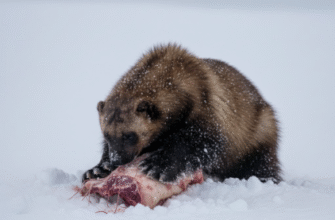
I used to think wolverines were just angry badgers on steroids.
Turns out, the relationship between a wolverine mother and her cubs is one of the most intricate teaching systems in the mustelid family—maybe in all of carnivorans, if you ask certain researchers who’ve spent decades in the boreal forests watching these animals that, honestly, would rather you didn’t. Female wolverines invest roughly 18 to 24 months raising their young, which is an absurdly long time for an animal that weighs maybe 30 pounds and has a metabolism like a furnace. During that period, cubs don’t just follow mom around hoping food falls from the sky. They’re learning a curriculum that includes caching strategies, territory navigation, prey selection, and something researchers are only beginning to understand: how to read a landscape for survival cues that won’t be obvious for another year or two.
The science here is messy, I’ll admit. Most of what we know comes from GPS collar data, scat analysis, and the occasional lucky observation by field biologists who are, frankly, freezing their asses off in northern Canada or Scandinavia. But the patterns are there.
Here’s the thing: wolverine mothers don’t just kill prey and let cubs eat. They create what biologist Audrey Magoun calls “teaching caches”—food stashes that cubs have to locate, excavate, and defend on their own, sometimes weeks after the kill. It’s like homework, except failure means starvation.
Wait—maybe that’s too harsh.
How Maternal Denning Behavior Shapes Cub Survival Instincts Over Eighteen Months
Wolverine dens are architectural marvels, dug into snowpack or subterranean tunnels that maintain stable temperatures even when it’s negative forty outside. Mothers rotate between multiple den sites during the first few months, and cubs have to memorize these locations. Researchers in Finland tracked one female who used seven different dens in a single season, moving cubs every 12 to 18 days. The hypothesis? She’s teaching them spatial memory and predator avoidance simultaneously. Because here’s the thing—wolves, bears, and even golden eagles will absolutely kill a wolverine cub if given the chance.
I guess it makes sense that cubs who survive to independence have mental maps of 300 to 500 square kilometers burned into their brains by the time they’re a year old.
The Peculiar Way Mothers Demonstrate Prey Handling to Inexperienced Hunters
This part gets weird. Wolverines are scavengers and hunters both, and mothers seem to adjust their teaching based on what’s available. In spring, when caribou calves are vulnerable, mothers will wound—but not kill—young ungulates, then step back and let cubs figure out the final takedown. It sounds brutal, and it definately is, but the learning curve is steep. One study in Alaska documented a mother bringing her cubs to a frozen moose carcass and spending three hours demonstrating how to chew through hide thickened by winter cold. The cubs tried, failed, tried again. She didn’t intervene unless they gave up entirely.
Anyway, that’s maternal patience I can’t even fathom.
Why Social Play Between Siblings Isn’t Just Roughhousing But Tactical Rehearsal
Cubs wrestle constantly—like, obsessively. Early researchers assumed it was just energy expenditure or dominance hierarchy stuff, but video analysis from Norwegian wildlife cameras revealed something more structured. Cubs practice neck bites, leg sweeps, and pinning maneuvers that mirror adult hunting techniques. Mothers sometimes join in, but mostly they watch from a distance, intervening only when play gets too rough or when one cub is clearly outmatched. There’s also evidence that mothers separate siblings temporarily to force independent problem-solving, which feels almost cruel until you remember that wolverines are solitary as adults and can’t afford to be co-dependent.
The timing of these separations correlates with prey abundance, interestingly enough.
What Vocalizations Reveal About Mother-Cub Communication Across Kilometers of Territory
Wolverines aren’t silent animals, despite their reputation. Mothers and cubs use a range of chuffs, growls, and high-pitched whistles that carry across tundra and forest. Bioacoustic research from Sweden identified at least 11 distinct call types, including what appears to be a “check-in” vocalization that cubs use when they’re separated from mom but not in immediate danger. Mothers respond with a lower-frequency call that seems to mean “I’m here, you’re fine.” The longest recorded distance for a successful vocal exchange? Just over two kilometers, though wind conditions matter a lot. What’s fascinating—and this is still speculative—is that cubs may learn individual hunting calls from their mothers, calls they’ll use later in life when defending caches or warning off competitors.
Honestly, I find that possibility strangely moving.
The Gradual Withdrawal Period When Mothers Force Independence and Cubs Sometimes Resist
Around 18 months, mothers start pushing cubs away—literally. She’ll growl, swat, even chase them off from kill sites. It’s not instant; the process takes weeks, sometimes months, and cubs don’t always recieve the message gracefully. Trail camera footage from Montana caught a subadult male trailing his mother for six weeks after she’d clearly dismissed him, keeping a distance of maybe 200 meters, scavenging her leftovers. She eventually chased him five kilometers into another drainage. He didn’t come back. This forced independence coincides with the mother’s next estrus cycle, which makes evolutionary sense but doesn’t make it any less harsh to watch. Cubs who fail to establish their own territories often die within the first year of independence—mortality rates hover around 40 to 60 percent depending on prey availability and human disturbance factors.
The ones who make it, though, carry forward every trick their mothers taught them.