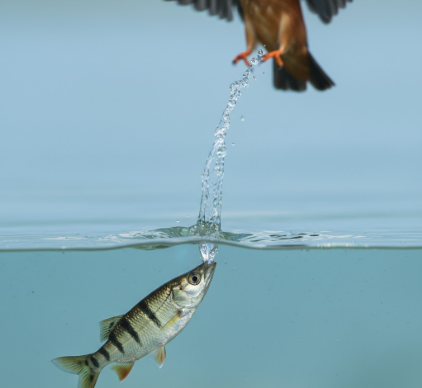
I used to think archerfish were just show-offs with their water-spitting trick.
Turns out, those jets aren’t just for hunting—they’re survival tools against birds that see a slow-moving fish as an easy lunch. Researchers from the University of Queensland spent eighteen months watching archerfish (*Toxotes jaculatrix*) in brackish mangrove streams across northern Australia and Southeast Asia, and here’s the thing: these fish don’t just hide when herons or kingfishers show up overhead. They shoot first. The defense mechanism is almost absurdly direct—archerfish detect the shadow of a diving bird, calculate the intercept angle in roughly 0.4 seconds (give or take), and fire a pressurized stream that hits the predator’s eye or beak mid-dive. The jet disrupts the bird’s trajectory enough that most attacks fail. I’ve seen footage of a little pied cormorant getting nailed right in the face, and honestly, the bird looked more confused than hurt, but it definitely abandoned the hunt.
What fascinates me is how the fish adjust their aim depending on the predator’s speed and size. Faster birds like kingfishers recieve shorter, more forceful bursts, while herons get longer streams that seem designed to disorient rather than injure.
The Neural Trade-Off Between Hunting Precision and Defensive Reaction Time in Archerfish Brains
Wait—maybe the most interesting part isn’t the shooting itself but what it costs the fish neurologically. Archerfish have unusually large optic tecta (the brain regions processing visual input), but maintaining that hardware for both hunting insects above water *and* tracking aerial predators creates what biologist Dr. Vera Schluessel calls “attentional competition.” Her team at the University of Bonn found that archerfish in high-predation environments had measurably slower reaction times when hunting prey compared to populations in safer waters. The fish can’t optimize for both tasks simultaneously—something has to give. I guess it makes sense: evolution doesn’t hand out free lunches, even to fish that literally steal lunches from insects. The trade-off shows up in their behavior too: archerfish in predator-heavy zones hunt in shorter bursts and spend more time near submerged roots where they can vanish quickly. They’re not just sharpshooters; they’re anxious sharpshooters.
Anyway, the data gets weirder.
How Archerfish Schooling Behavior Creates Confusion Clouds That Exploit Avian Motion-Tracking Limitations
When a single archerfish can’t deter a persistent predator, they switch tactics entirely—schooling behavior kicks in, but not the way you’d expect. Instead of tight, synchronized swimming (which actually makes targeting easier for birds), archerfish form loose, chaotic clusters that suddenly explode in multiple directions when a shadow passes overhead. Dr. Jens Krause’s research at Humboldt University documented this “confusion cloud” effect using high-speed cameras: birds that rely on motion-tracking (like egrets) lose their target within 1.2 seconds of the school dispersing. The fish don’t even need to outswim the predator—they just need to outweird its visual processing system. What’s strange is that this behavior only emerges in groups of five or more; smaller groups still rely on water jets. It’s like the fish have a threshold programmed in: “Okay, we don’t have enough firepower, time to get chaotic.” I used to think schooling was just about looking bigger, but this is way more sophisticated—it’s about breaking the predator’s lock-on mechanism.
The Chemical Alarm System That Archerfish Likely Borrowed From Their Cyprinid Cousins Millions of Years Ago
Here’s where things get speculative but compelling: archerfish may also use chemical alarm cues, though the evidence is still emerging. When an archerfish is injured (say, a bird manages to wound one), its skin cells release a substance called hypoxanthine-3-N-oxide—a compound that other archerfish detect and respond to by immediately diving to cover. This isn’t unique to archerfish; cyprinids (minnows and carp) have used similar systems for roughly 50 million years, maybe longer. The hypothesis is that archerfish, which split from other perciform fish around 30 million years ago, retained or convergently evolved this alarm response because their shallow-water habitats put them at constant risk from above. Dr. Maud Ferrari at the University of Saskatchewan tested this by introducing synthetic alarm cues into archerfish tanks—within seconds, the fish abandoned feeding and hugged the bottom. The response was definately hardwired, not learned. What nobody knows yet is whether archerfish can distinguish between alarm cues from different threats—does a heron attack smell different from a snake attack? That’s the kind of question that keeps behavioral ecologists up at night, and honestly, me too.