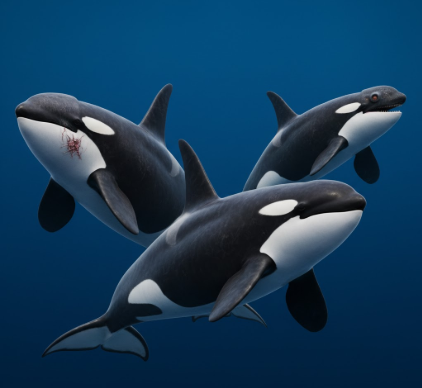
Orcas don’t just hunt—they architect violence with a precision that makes you reconsider what intelligence actually means in the ocean.
I used to think apex predators were basically just bigger, meaner versions of their prey, you know, like a shark is just a fish with better teeth. But watching footage of orcas flipping great whites upside down to induce tonic immobility, then surgically extracting only the liver—ignoring tons of perfectly good meat—I realized these animals operate on a different cognitive level entirely. They’re not just reacting to hunger. They’re executing strategies that get passed down through matrilineal lines, refined over generations, adapted to local prey in ways that look less like instinct and more like, wait—maybe culture? Marine biologists have documented at least ten distinct orca ecotypes globally, each with specialized hunting techniques so specific they won’t even interbreed. The transient orcas off California’s coast speak a different dialect and hunt marine mammals exclusively, while residents a few miles away eat only fish and vocalize in completely different patterns. It’s like stumbling onto parallel civilizations that just happen to share the same species name.
The Anatomical Arsenal That Makes Cooperative Carnage Possible
Here’s the thing: orca physiology is basically over-engineered for violence. Their teeth—about 3 inches long, conical, interlocking—aren’t designed for chewing but for gripping struggling prey while the animal thrashes. The real damage happens from brute force: ramming, tail-slapping, drowning. Their brains weigh around 15 pounds (compared to our measly 3), with a highly developed limbic system that suggests complex emotional processing. That insula cortex? Proportionally larger than ours, which might explain why they seem to coordinate attacks with what researchers describe as almost eerie synchronization.
And then there’s echolocation—biological sonar so sophisticated it can distinguish between different species of salmon based on swim bladder resonance alone. Orcas can “see” inside your body with sound, mapping bone density, locating a seal’s position under six feet of ice. Honestly, it’s the kind of sensory superpower that makes human vision feel quaint. Their dorsal fins act as thermoregulators and possibly even social signaling devices, though that part’s still debated. Males’ fins can reach six feet tall, which seems excessive until you realize everything about orcas is excessive—including their global distribution from Arctic to Antarctic waters, a range virtually no other apex predator matches.
Cultural Transmission of Hunting Techniques Across Oceanic Populations
Patagonian orcas beach themselves intentionally to snatch seal pups from the shoreline, then wriggle back into the water—a behavior so risky that mothers spend years teaching calves the exact angle and timing. Meanwhile, Antarctic orcas have perfected “wave-washing,” where pods swim in formation to create swells that knock seals off ice floes. These aren’t genetic behaviors. They’re taught. I guess it makes sense when you consider orcas have the second-longest post-reproductive lifespan of any animal (after humans), with grandmothers living decades past fertility to mentor younger generations. That knowledge transfer is the actual adaptation—not bigger teeth or faster swimming, but the ability to innovate, then disseminate, then refine techniques across decades.
New Zealand orcas have been observed targeting stingrays specifically, flipping them to avoid the barb—a tactic that appeared suddenly in the 1990s and spread through the population within years. Researchers documented individual animals watching, then attempting, then mastering the maneuver. Turns out, social learning in orcas rivals primates in complexity, which is deeply uncomfortable if you’ve ever eaten fish without thinking about whether it had family recipes.
Why No Natural Predators Dare Challenge Them Anymore Apparently
The short answer is: orcas hunt everything, and nothing hunts them back. Great whites flee when they detect orca vocalizations in the water—one study off South Africa’s coast found sharks abandoned prime hunting grounds for months after a single orca attack, leaving seal colonies unmolested. Even sperm whales, which outweigh orcas by tens of tons, form defensive circles when pods approach, protecting calves at the center like some kind of Cretaceous-era survival strategy. The fossil record suggests orcas evolved roughly 11 million years ago, give or take, and they’ve been refining this apex status ever since, adapting to every ocean environment with a flexibility that’s honestly kind of terrifying. They’ve even been documented attacking blue whales—the largest animals ever to exist—targeting calves during migration.
What makes orcas functionally untouchable isn’t size or strength alone but behavioral plasticity combined with social cohesion. A solitary orca is dangerous; a pod is a distributed intelligence network with teeth. And maybe that’s the real adaptation: they didn’t just evolve bodies for killing—they evolved societies for it.