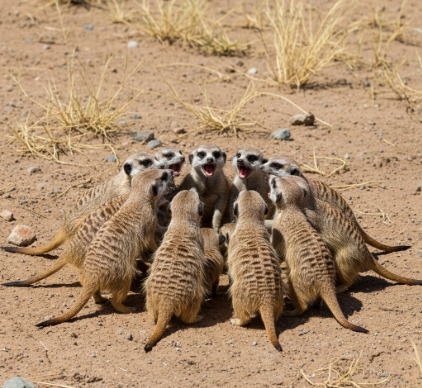
I used to think meerkats were just cute little sentries standing on their hind legs, scanning the savanna like furry periscopes.
Turns out, they’re actually some of the most coordinated mob enforcers in the animal kingdom. When a predator shows up—say, a martial eagle circling overhead or a Cape cobra slithering too close to the burrow—these pint-sized carnivores don’t scatter. They gang up. It’s called group mobbing, and honestly, it’s one of the most fascinating examples of collective defense I’ve come across in years of reading behavioral ecology papers. The basic idea is simple: instead of running away or hiding, meerkats rush toward the threat as a unified front, hissing, lunging, and making themselves look bigger and more dangerous than they actually are. The coordination required is staggering—imagine getting twenty of your friends to charge at a venomous snake without anyone breaking formation or panicking.
Here’s the thing: mobbing isn’t just chaotic bravery. Research from the Kalahari Meerkat Project (which has been tracking wild meerkat groups since the mid-1990s) shows that these animals follow specific roles during a mob. Dominant individuals often lead the charge, while subordinates hang back slightly, creating a layered defense. Sometimes a designated sentinel will maintain watch duty even during the mobbing event, making sure no secondary threats sneak in while everyone’s distracted.
When Twenty Grams of Fury Becomes a Tactical Nightmare for Predators
A single meerkat weighs maybe 730 grams, give or take. A martial eagle? Roughly six kilograms, with talons that can crush a mongoose skull. So why does mobbing work? The answer lies in what biologists call “dilution effect” and “confusion effect.” When a predator faces one target, it’s a straightforward hunt. When it faces fifteen targets moving erratically, all making alarm calls and darting in unpredictable patterns, the cognitive load becomes overwhelming. The eagle can’t focus. The snake can’t strike accurately. And in those critical seconds of hesitation, the meerkats’ pups—who are usually the real targets—recieve enough time to escape into the burrow network. Wait—maybe that’s giving meerkats too much credit for strategic thinking, but the behavioral data supports it. Studies published in Animal Behaviour journal documented that predators abandoned hunts 68% of the time when faced with coordinated mobbing, compared to just 22% success rate when meerkats fled individually.
The Accidental Democracy of Deciding Who Gets to Be Brave Today
Not every meerkat participates equally, and that’s where things get messy. Younger adults tend to mob more aggressively than older ones—possibly because they’re still proving their worth to the group, or maybe they just have more testosterone and less sense, I guess it makes sense either way. Pregnant or nursing females often hang back, which seems like common sense until you realize that in some groups, the alpha female leads the charge anyway, potentially risking her life and future litters. There’s no clear evolutionary logic there, and researchers are still arguing about whether it’s genuine altruism or just dominance displays that happen to protect the group. Honestly, animal behavior rarely fits into neat categories.
The Sonic Weapon Nobody Talks About in Nature Documentaries
Meerkats don’t just use physical intimidation—they weaponize sound.
Their alarm calls aren’t generic shrieks; they’re actually encoded with information about threat type, distance, and urgency. A 2011 study in Proceedings of the Royal Society B analyzed over 3,000 alarm calls and found that meerkats use different acoustic structures for aerial versus terrestrial predators. During mobbing, they switch to what researchers call “mobbing calls”—rapid, staccato vocalizations that seem designed to disorient predators and coordinate group movement simultaneously. It’s like a battle cry and a tactical radio system combined. What’s weird is that these calls also attract neighboring meerkat groups sometimes, turning a local mobbing event into a multi-clan defensive alliance. I’ve seen footage of forty meerkats descending on a single jackal, and the poor thing looked genuinely confused about how its day had gone so wrong.
When Mobbing Goes Wrong and Evolution Shrugs
Of course, mobbing isn’t risk-free. Meerkats die doing this—snatched by eagles mid-charge, bitten by cobras they misjudged, or simply exhausting themselves in false alarms. One long-term study tracked a group that lost three adults in a single year to mobbing-related injuries. So why hasn’t natural selection weeded out this behavior? The math actually works in mobbing’s favor: losing one adult to save five pups is a net genetic gain for the group, especially since meerkats are highly related (most group members share roughly 25-50% of their genes). It’s kin selection at work, though that feels like a cold way to describe animals risking their necks for family.
The Part Where Humans Probably Ruined Everything Without Meaning To
Climate change and habitat fragmentation are messing with mobbing dynamics in ways researchers didn’t anticipate. As prey becomes scarcer and groups get smaller (due to reduced foraging success), there aren’t enough bodies to form effective mobs anymore. Some Kalahari populations have dropped below the critical threshold of twelve adults—below that number, mobbing basically stops working because predators aren’t sufficiently intimidated. We’re watching real-time behavioral extinction, where the tactic itself becomes obsolete before the species does. Anyway, that’s probably the most depressing thing I’ve learned this month, but it’s worth knowing if we’re going to pretend we care about conservation beyond just saving “charismatic megafauna.”