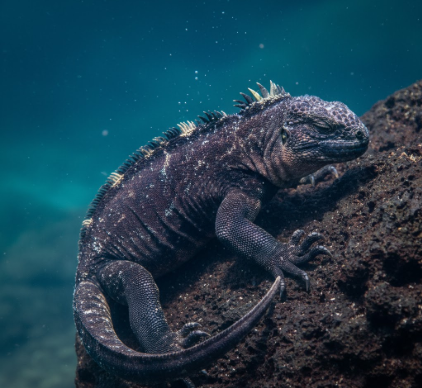
I used to think marine iguanas were just regular lizards that happened to live near water.
Turns out, these creatures—found only in the Galápagos Islands—are doing something no other lizard on Earth can pull off: they’re diving into cold ocean water, sometimes down to 30 feet or more, and staying under for what feels like an impossibly long time. We’re talking 30 to 45 minutes in some cases, though most dives last around 5 to 10 minutes. That’s not just impressive for a reptile; it’s borderline absurd when you consider that their entire evolutionary history suggests they should be sun-basking specialists, not deep-sea foragers. But here’s the thing: evolution doesn’t care about what “should” happen. These iguanas needed food—specifically, algae growing on underwater rocks—and their bodies figured out a way to make it work, even if it meant rewriting some pretty fundamental rules about how reptilian physiology operates.
The Metabolic Shutdown That Defies Common Sense in Cold-Blooded Animals
Marine iguanas drop their heart rate dramatically when they dive. I mean dramatically—from roughly 45 beats per minute down to something like 10 or even fewer. It’s a bradycardic response that would probably send a human into cardiac arrest, but for these lizards, it’s just Tuesday. What’s happening here is a kind of metabolic throttling: by slowing the heart, they’re reducing oxygen consumption across their entire body, buying themselves extra time underwater. Cold water helps, weirdly enough—it slows their metabolism even further, which you’d think would be a problem for a reptile that relies on external heat to function, but in this case it’s actually extending their dive time. Wait—maybe that’s why they bask so obsessively after each dive, lying there like solar panels recharging. Their body temperature can drop several degrees during a dive, and they need that sun to get back to operational levels.
Oxygen Storage Systems That Make Mammalian Divers Look Almost Ordinary
Here’s where it gets technical. Marine iguanas store oxygen in their blood—specifically in hemoglobin—but also in their muscles via myoglobin, which is that protein that makes meat red. They’ve got higher concentrations of both compared to terrestrial iguanas, which gives them a bigger oxygen reservoir to pull from when they’re underwater and can’t breathe. Some research suggests they might also tolerate lactic acid buildup better than other reptiles, which is crucial because anaerobic metabolism kicks in when oxygen runs low, and that process produces lactic acid as a byproduct. Most animals hit a wall pretty fast when lactic acid accumulates; it’s painful, it’s limiting, and it forces you to surface. Marine iguanas seem to shrug it off, at least for a while.
I’ve seen videos of them feeding underwater, and honestly, it looks uncomfortable—like they’re fighting every instinct to get back to air.
The Nasal Gland Workaround for Dealing With Salt That Would Kill Most Reptiles
Okay, so they’re underwater, holding their breath, eating algae. But algae in the ocean is salty—really salty—and ingesting that much salt should be a death sentence for a reptile. Their kidneys can’t handle it the way mammalian kidneys might. So what do they do? They’ve evolved specialized nasal salt glands that excrete concentrated salt solutions, which they then sneeze out in these dramatic little bursts. You’ll see them on the rocks, post-dive, sneezing salt spray everywhere like tiny, scaly geysers. It’s oddly charming and also a reminder that evolution is deeply weird. This adaptation isn’t directly about breath-holding, but it’s part of the package that makes their whole lifestyle possible—you can’t be an underwater herbivore if you die from salt poisoning after every meal, give or take a few dives.
The whole system is interconnected in ways that feel almost improvised.
Marine iguanas also exhibit what’s called “selective vasoconstriction,” which is a fancy way of saying they can shut down blood flow to non-essential body parts during a dive. Blood gets rerouted to the brain and heart—the organs that absolutely must keep running—while everything else goes on standby. This is similar to what seals and whales do, which is wild because marine iguanas aren’t marine mammals; they’re reptiles that stumbled into the ocean maybe 5 to 10 million years ago, evolutionarily speaking, and figured out a lot of the same tricks independently. Convergent evolution is always satisfying to see in action, even if the timescales involved make my brain hurt. I guess it makes sense that certain problems—like “how do I not drown while looking for food”—have a limited set of viable solutions, and different lineages keep arriving at similar answers. Still, every time I think about a lizard doing something a seal does, I feel like the universe is showing off.
There’s also evidence that younger, smaller iguanas can’t hold their breath as long as the big adults, which tracks with the idea that body size and oxygen storage capacity are linked—larger animals have more blood volume, more muscle mass, and therefore more total oxygen to work with. But it also means juvenile iguanas are probably taking bigger risks every time they dive, operating closer to their physiological limits, which is a rough way to grow up. Anyway, they manage. They’ve been managing for millions of years, which is more than most species can say.