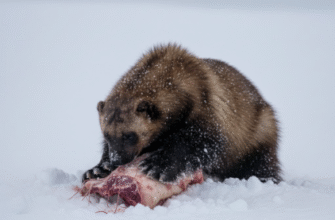
I used to think wolverines were just angry badgers on steroids.
Turns out, these solitary carnivores are basically the endurance athletes of the mustelid family, covering distances that would make a ultramarathoner weep. A single wolverine can traverse up to 15 miles in a single day—and that’s just a Tuesday for them. Scientists tracking wolverines in Montana recorded one individual traveling over 500 miles in a three-week period, crossing mountain ranges, highways, and frozen rivers like it was nothing. Their oversized paws work like natural snowshoes, distributing their weight across deep powder, which means they can hunt and scavenge in places where other predators literally sink and give up. The metabolic cost of this constant movement is staggering, which is exactly why they need to cover so much ground: they’re searching for enough calories to fuel their relentless wandering.
Here’s the thing—wolverines aren’t picky eaters, and that’s part of their survival strategy. They’ll take down prey as large as deer when they can, but mostly they’re scavengers, following wolves and mountain lions to steal cached kills. This means their entire existence revolves around a grueling calculus of energy in versus energy out.
The Brutal Mathematics of Staying Alive in Frozen Landscapes
A wolverine’s territory can span anywhere from 100 to 600 square miles depending on food availability and sex—males roam significantly farther than females. In places like the Yukon or northern Scandinavia, where winter lasts eight months and prey is scattered across vast tundra, a wolverine might not encounter a substantial meal for days. They’ve adapted to this feast-or-famine existence with a digestive system that can process bones, frozen meat, and even hide. When they do find a carcass—say, a caribou that died in an avalanche—they’ll gorge themselves, sometimes consuming several pounds in one sitting, then cache the remains under snow or rocks for later. Honestly, it’s like they’re running a distributed refrigeration system across an entire mountain range. But the caching behavior also means they need to remember dozens of locations scattered across hundreds of miles, which requires both exceptional spatial memory and the willingness to keep moving even when exhausted.
Wait—maybe that’s why they’re so notoriously aggressive. Sleep-deprived and perpetually hungry is not a good combination.
How Climate Patterns Dictate Their Wandering Routes and Timing
Wolverines depend on persistent spring snowpack for denning, which means climate change is literally shrinking their viable habitat. Females dig dens deep in snow to give birth, and kits need that insulation to survive. As snow melts earlier and winter ranges contract, wolverines are being pushed into higher elevations and more marginal territories, which forces them to travel even greater distances to find adequate denning sites and sufficient food. A 2019 study tracking GPS-collared wolverines in the Cascades found individuals making perpindicular climbs of over 3,000 feet in a single day, apparently searching for snow patches that lasted into May. The researchers noted that these animals were spending more energy on vertical movement than their counterparts did a decade earlier.
I guess it makes sense that an animal already adapted for extremes would just push harder when conditions deteriorate.
Sensory Superpowers That Make Long-Distance Hunting Actually Possible
Wolverines have an sense of smell that borders on supernatural—they can detect carrion buried under 20 feet of snow. This olfactory superpower is what makes their long-distance travel productive rather than just exhausting; they’re not wandering randomly, they’re following scent corridors that we can’t even percieve. Their nose leads them to avalanche sites, predator kills, and even hibernating ground squirrels. Combined with their tireless gait and ability to traverse terrain that stops other predators cold, wolverines occupy an ecological niche that’s equal parts scavenger, predator, and wilderness survivalist. Some biologists describe them as “opportunistic carnivores with poor impulse control,” which, honestly, feels accurate. They’ll investigate anything that smells remotely edible, even if it means adding another five miles to an already brutal day.
Why Genetic Diversity Depends on These Massive Home Ranges
The massive distances wolverines travel aren’t just about food—they’re also critical for genetic exchange. Because wolverines exist at such low population densities, individuals need enormous ranges to encounter potential mates. Young males, especially, will disperse hundreds of miles from their birth territory, sometimes crossing into entirely different mountain ranges. This wandering prevents inbreeding and maintains genetic diversity across fragmented populations. A wolverine tagged in Wyoming was later detected in Colorado, having crossed urban areas and interstate highways to get there. These corridors are becoming increasingly important as human development fragments wilderness areas.
Anyway, next time you see a wolverine depicted as just a snarling ball of rage, remember: they’re actually snarling balls of rage who can run a marathon before breakfast.