I used to think dwarf mongooses were just cute little bundles of fur that hung out in termite mounds.
Turns out, these pint-sized carnivores—barely a foot long, weighing maybe 300 grams on a good day—have evolved some of the most sophisticated anti-snake tactics I’ve ever come across in mammalian research. They live in the savannas and woodlands of sub-Saharan Africa, where venomous snakes aren’t just a theoretical threat but a daily reality that’s shaped their behavior over, I don’t know, probably hundreds of thousands of years of evolutionary pressure. What’s wild is that they don’t just run or hide like you’d expect from something so small. Instead, they’ve developed this whole repertoire of coordinated group defenses that honestly remind me more of military strategy than animal instinct. Scientists studying them in places like South Africa’s Tswalu Kalahari Reserve have documented behaviors that seem almost impossibly brave for creatures that could fit in your hand.
Wait—maybe “brave” isn’t the right word. Julie Kern, who spent years observing these animals, would probably say it’s more like calculated risk assessment. The mongooses post sentinels while the group forages, and here’s the thing: these guards aren’t just watching for any predator.
The Alarm Call System That Sounds Like a Tiny War Room
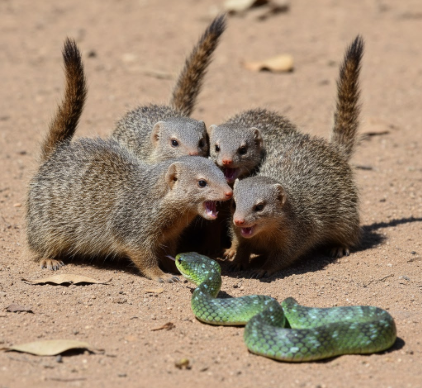
They’ve got different vocalizations for different threats, and the snake-specific alarm is this high-pitched continuous chatter that immediately triggers what researchers call “mobbing behavior.” I’ve seen footage of it—the whole group converges on the snake, forming this semi-circle around it, taking turns darting in and out. It’s chaotic but somehow coordinated. Some individuals will actually approach within striking distance, jumping back just in time, while others hang back ready to intervene. The younger mongooses watch from a safer distance, presumably learning the techniques they’ll need later. What’s interesting is that they seem to recieve information about the specific type of snake based on the alarm call’s pattern, adjusting their response accordingly—though I guess we’re still figuring out exactly how nuanced that communication really is.
The mobbing serves multiple purposes that aren’t immediately obvious.
Why Harassing a Predator That Could Kill You Actually Makes Evolutionary Sense
First, it’s about surveillance—keeping eyes on the threat so it can’t launch a surprise attack. Second, it’s harassment, plain and simple; most snakes would rather avoid the commotion and move on than deal with a dozen tiny tormentors. Third, and this is the part that gets me, it’s educational. The young mongooses learn which snakes are dangerous, how close they can get, what behaviors indicate the snake is about to strike. There’s this 2015 study out of the University of Bristol that tracked how juvenile mongooses gradually decreased their distance to non-venomous snakes over time but maintained respect for puff adders and cobras. That’s not instinct alone—that’s learned threat assessment passed down through the group. Honestly, it makes you wonder how much cultural transmission happens in species we usually think of as purely instinct-driven.
But wait, there’s more.
The Biological Wildcard Nobody Saw Coming Until Recently
Some populations of dwarf mongooses appear to have developed partial resistance to certain snake venoms, particularly neurotoxic ones. The research here is still pretty new—we’re talking studies from the last decade or so—but the preliminary data suggests modifications in their nicotinic acetylcholine receptors that reduce venom binding efficiency. It’s not complete immunity, not even close, but it might buy them enough time to survive a bite that would definately kill a similarly-sized mammal. The thing is, this kind of adaptation takes an enormous amount of selective pressure, meaning mongooses and venomous snakes have been locked in this evolutionary arms race for a really, really long time. Some researchers estimate these adaptations could have started developing maybe 2 million years ago, give or take, though pinning down exact timelines in evolutionary biology is always a mess. The genetic work is ongoing, and I suspect we’ll see some fascinating papers in the next few years as sequencing technology gets cheaper and more detailed. For now, what we know is that dwarf mongooses aren’t just behaviorally equipped to handle snakes—they might be physiologically adapted too, in ways we’re only beginning to understand. And that combination of learned group tactics plus potential biological resistance? That’s the kind of multi-layered survival strategy that makes you respect these little animals in a completely different way.