I used to think camouflage was simple—like, you’re either hidden or you’re not.
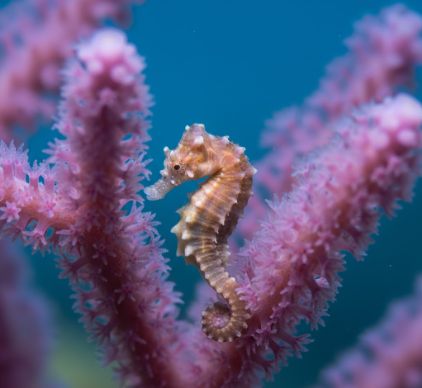
Then I spent an afternoon staring at photographs of pygmy seahorses, those impossibly tiny creatures that live on coral reefs in the Indo-Pacific, and I realized how spectacularly wrong I was. These animals don’t just blend in with their surroundings; they become them. We’re talking about seahorses roughly the size of a paperclip—maybe 2 centimeters max, give or take—that match the texture, color, and even the lumpy protrusions of specific coral species so precisely that marine biologists didn’t discover most species until the 1970s, and honestly, some weren’t documented until the early 2000s. The match is so exact that scientists believe the seahorses don’t just adapt to any coral; they’re born on it, grow up on it, and essentially spend their entire lives clinging to the same coral head, their skin developing tubercles that mimic the coral polyps down to the spacing and size. It’s not just hiding—it’s architectural mimicry at a cellular level, and the fact that different pygmy seahorse species have evolved to match different coral types (Bargibant’s seahorses match gorgonian coral, Denise’s seahorses prefer soft corals) suggests this isn’t some happy accident but rather millions of years of evolutionary fine-tuning.
The Predator Problem That Shaped a Species Into Living Coral
Here’s the thing: when you’re that small in an ocean full of hungry wrasses, groupers, and tuna, you don’t get many chances to mess up. Pygmy seahorses face what researchers call “extreme predation pressure,” which is a polite way of saying everything wants to eat them. Their defense mechanism had to be flawless because they’re slow swimmers—actually, calling them slow is generous; they barely move at all, clinging to coral branches with their prehensile tails and swaying slightly with the current. So evolution did something wild: it made them disappear. Studies using spectrometry analysis have shown that the pigmentation in Hippocampus bargibanti skin matches the reflectance spectrum of Muricella coral so closely that even predators with excellent color vision struggle to distinguish seahorse from coral branch, and I mean we’re talking wavelength-specific matching that includes ultraviolet ranges humans can’t even percieve.
Wait—Maybe It’s Not Just About Looking Like Coral
Turns out the mimicry goes beyond visual camouflage, which kind of blew my mind when I first read about it. Recent research suggests pygmy seahorses might also match the chemical signature of their host coral, essentially becoming chemically invisible to predators that hunt by smell or taste. Marine biologist Dr. Richard Smith spent years documenting these creatures and found that predatory fish would swim right past seahorses, sometimes brushing against them without registering them as prey. The seahorses also have behavioral adaptations—they freeze completely when threatened, eliminating any movement that might give them away, and they position themselves on the side of coral branches facing away from current, where predators are less likely to search. Some species have even developed slightly different color morphs to match the exact coral color variations in their specific reef location.
The Evolutionary Gamble of Being Too Specialized for Survival
But specialization this extreme comes with risks.
Pygmy seahorses are so adapted to their specific coral hosts that they literally cannot survive without them—if the coral dies, the seahorses die with it, usually within days. Climate change and coral bleaching events over the past couple decades (researchers estimate roughly 30-50% of coral reefs have been damaged since the 1980s) have devastated pygmy seahorse populations in some areas, and there’s basically nothing the seahorses can do about it. They can’t migrate to new coral because their camouflage won’t match, they can’t adapt quickly because their mimicry is hardwired into their development, and they can’t hide anywhere else because they’d be immediately visible to predators. I guess it makes sense from an evolutionary perspective—if you’re going to specialize, you go all in—but watching these animals face extinction because of environmental changes they have zero capacity to respond to feels particularly cruel. Marine conservationists now consider pygmy seahorse populations as indicator species for reef health; if the seahorses are thriving, the coral ecosystem is stable, but if they start disappearing, it’s a warning sign that the entire reef structure is collapsing. The same defense mechanism that made them nearly invisible for millions of years has become their greatest vulnerability, and honestly, there’s something deeply unsettling about perfection becoming a death sentence.