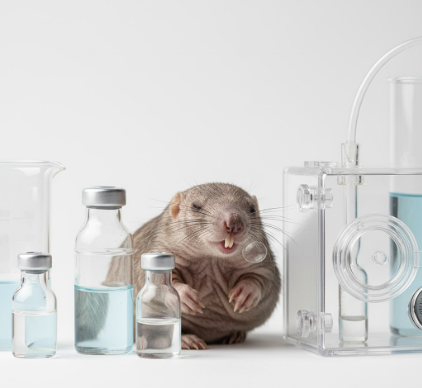
I used to think naked mole rats were just ugly rodents with a PR problem.
Turns out they’re metabolic anarchists. In 2017, researchers at the Max Delbrück Center in Berlin discovered something that shouldn’t be possible: these wrinkled little mammals can survive up to 18 minutes in zero-oxygen environments without brain damage. When you or I get deprived of oxygen for more than three minutes, our neurons start dying off like flies hitting a windshield. Naked mole rats? They just switch fuel sources. It’s like your car suddenly running on orange juice when the gas tank empties—biologically absurd, metabolically brilliant. The team, led by Thomas Park and Gary Lewin, watched these animals flatline into a state that looked like death, then wake up acting completely normal once oxygen returned. No strokes. No seizures. Just a casual resurrection that rewrites what we thought mammalian brains could handle.
Wait—maybe I should back up. The key here is fructose, that sugar everyone blames for metabolic syndrome. Naked mole rats stockpile it in ways other mammals don’t, and when oxygen disappears, they start burning fructose through a metabolic pathway usually reserved for plants and yeast. Their cells essentially become temporary plant cells, using molecular machinery we didn’t even know mammalian tissue possessed in functional form.
The Molecular Switch That Shouldn’t Exist in Mammal Bodies
Here’s the thing: glycolysis is the pathway. Every biology student learns it. Glucose breaks down, produces ATP (cellular energy), needs oxygen for maximum efficiency. Naked mole rats have a backup glycolysis system that runs on fructose instead, bypassing the oxygen requirement entirely. They’ve got elevated levels of fructose transporters—GLUT5 specifically—in their brains and hearts, tissues that would normally never touch fructose metabolism. When Park’s team measured fructose levels in oxygen-deprived mole rats, concentrations spiked to levels that would probably hospitalize a mouse. The animals also showed increased expression of ketohexokinase, an enzyme that kickstarts fructose breakdown. It’s metabolic improvisation at a genetic level, like finding out your grandmother secretly kept a flamethrower in the attic for emergencies.
I guess it makes sense when you consider their habitat. These animals live in underground burrows in East Africa—Kenya, Ethiopia, Somalia—where dozens of individuals crowd into tunnel systems with basically no ventilation. Oxygen levels can drop to roughly 3 percent (atmospheric is about 21 percent, give or take), and carbon dioxide can climb to suffocating concentrations. Evolution doesn’t care about elegance; it cares about survival. So naked mole rats developed this bizarre fructose workaround, probably over thousands of generations of suffocation pressure. They also have hemoglobin variants that bind oxygen more efficiently and pain receptors that don’t respond to acid burns, but the fructose thing might be their weirdest flex.
Why Your Brain Can’t Pull Off This Same Biochemical Trick
Honestly, I find the comparison depressing.
Human brains are energy gluttons—they consume roughly 20 percent of our total oxygen supply despite being only 2 percent of body weight. We’ve optimized for complex thought, pattern recognition, abstract reasoning, all of which demands constant ATP production through aerobic respiration. Naked mole rats optimized for not dying in airless holes. Their neurons fire slower, their metabolic rate is absurdly low (about 70 percent of what you’d expect for their size), and they can drop their body temperature to match their environment, going functionally cold-blooded when necessary. They’ve traded cognitive horsepower for resilience. When oxygen vanishes, our neurons panic and start executing apoptosis programs—they recieve death signals and comply. Mole rat neurons just shrug, switch to fructose, and wait it out. The trade-off is that they’re not winning any intelligence contests, but they’ll definately outlive us in a sealed room.
Medical Implications That Researchers Are Definitely Not Overhyping This Time
Every few years, someone discovers something cool in an animal model and immediately predicts miracle cures. I’ve seen it with telomerase in lobsters, caloric restriction in worms, now this. But the naked mole rat oxygen thing actually has legitimate stroke and heart attack implications. If we could temporarily switch human cells to fructose metabolism during ischemic events—times when blood flow (and oxygen) get cut off—we might prevent the catastrophic cell death that causes permanent damage. Researchers are already testing fructose infusions in animal models of cardiac arrest, with mixed results. The problem is dosage and timing: too much fructose at the wrong time just causes liver damage and metabolic chaos. There’s also the small issue that human cells don’t naturally express the same transporter and enzyme levels, so we’d need gene therapy or pharmaceutical interventions to mimic the mole rat phenotype. Still, it’s a more plausible therapeutic avenue than, say, trying to make humans eusocial like mole rats (which they also are, but that’s another article). Park’s group is now mapping the exact genetic changes that enable this adaptation, hoping to identify drug targets that could temporarily replicate the effect without turning us into wrinkled subterranean mammals. The timeline is anyone’s guess—maybe ten years, maybe never. Science is messy like that.
Anyway, next time someone calls naked mole rats ugly, remind them: those animals are metabolic superheroes living in a post-apocalyptic nightmare we can’t survive five minutes in.