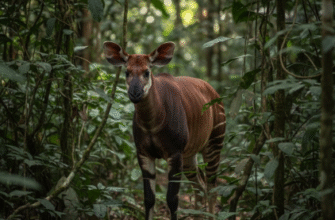
I used to think okapis were just weird forest zebras until I saw one at the Bronx Zoo and noticed those stubby little horns.
Turns out, those aren’t horns at all—they’re ossicones, the same bony protrusions that giraffes have, except okapis wear theirs like understated jewelry instead of the giraffe’s dramatic crown. Ossicones are skin-covered bone structures that grow directly from the skull, unlike antlers (which deer shed annually) or true horns (which have a keratin sheath over a bony core). In okapis, only males have them, and they’re typically around 5-6 inches long, which seems almost comically modest compared to a giraffe’s setup. But here’s the thing: these structures aren’t decorative accidents—they’re evolutionary signatures, fossils of a shared ancestry that goes back roughly 11 million years, give or take a few hundred thousand. The okapi (*Okapia johnstoni*) and the giraffe are the only two surviving members of the family Giraffidae, and their ossicones are one of the clearest anatomical breadcrumbs linking them together. Even though okapis live in dense Congolese rainforests and giraffes roam African savannas, their skulls tell the same story.
Anyway, the reason okapis inherited ossicones has everything to do with what their common ancestor looked like. Paleontologists have found fossilized giraffids from the Miocene epoch with similar bony skull protrusions, suggesting that ossicones were a standard-issue feature for this family long before the evolutionary split. Male okapis use their ossicones for sparring—not the brutal head-smashing you see in bighorn sheep, but more like ritualized shoving matches to establish dominance during mating season. I’ve seen footage of this, and honestly, it looks almost polite compared to other ungulate combat.
The Evolutionary Baggage Nobody Asked For But Everyone Kept
So why didn’t okapis just lose the ossicones if they’re living in dense forest where long necks and tall structures seem like liabilities? Evolution doesn’t work like a tidy renovation project—it’s more like inheriting your grandmother’s house and keeping the weird chandelier because removing it would crack the ceiling. Ossicones in okapis are developmentally tied to their skull growth patterns, controlled by genes that also influence other craniofacial features. Removing them from the blueprint might destabilize other structures, or maybe—wait—maybe they’re just neutral enough that natural selection hasn’t bothered to edit them out. They don’t cost much energy to maintain, they don’t interfere with browsing vegetation, and males get some mating advantage from them. That’s usually enough for evolution to shrug and move on.
There’s also the possibility that ossicones serve functions we haven’t fully documented yet. Some researchers speculate they might play a role in thermoregulation or even sensory perception, though the evidence is pretty thin. Giraffes defintely use theirs for fighting, and their ossicones are often worn smooth on top from repeated impacts. Okapi ossicones, by contrast, stay relatively pristine, which suggests they’re either used more carefully or serve a more symbolic role in social hierarchies.
I guess what strikes me most is how okapis carry this giraffe heritage into an environment that couldn’t be more different.
What Ossicones Reveal About Evolutionary Constraints and Compromises
The presense of ossicones in both species also highlights how evolutionary traits can persist across dramatic ecological shifts. When the ancestors of modern okapis moved into Central African rainforests—probably during climatic changes in the late Miocene or early Pliocene—they didn’t undergo a total morphological overhaul. They kept their ossicones, their long tongues (okapi tongues can reach up to 18 inches, perfect for stripping leaves), and their unique gait pattern. But they traded the giraffe’s extreme neck elongation for a more compact body suited to navigating understory vegetation. It’s like evolutionary luggage: you bring what fits in the overhead bin and check the rest. Ossicones made the cut because they were small enough, useful enough, or at least harmless enough to justify the ticket.
And here’s the thing—ossicones aren’t just a curiosity for zoologists. They’re a reminder that evolution is less about optimization and more about “good enough.” Okapis didn’t need to become perfect forest dwellers; they just needed to survive better than the alternatives. Their ossicones are a compromise, a inheritance, a vestige of savannas they’ll never see again. Sometimes I think about that when I’m staring at my own vestigial traits—wisdom teeth, goosebumps, the appendix—and I feel a weird kinship with these striped, secretive animals wandering the Ituri Forest with tiny giraffe crowns they didn’t ask for but can’t quite abandon.
Evolution doesn’t clean up after itself very well, and okapis are living proof.