
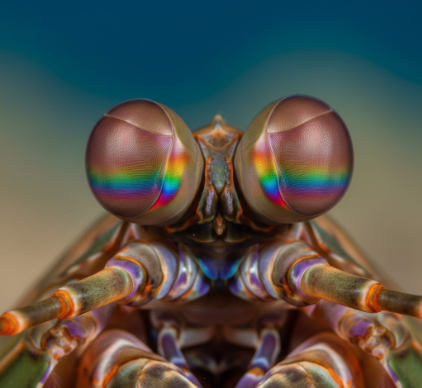
I used to think octopuses had the weirdest eyes in the ocean, until I spent an afternoon staring at mantis shrimp through aquarium glass.
Here’s the thing: mantis shrimp—these thumb-sized crustaceans that look like they were designed by a committee of surrealists—possess the most complex visual system ever documented in any animal. Each eye contains 12 to 16 photoreceptor types, compared to our measly three. They can detect ultraviolet, visible, and polarized light simultaneously, processing wavelengths we can’t even imagine. Their eyes move independently on stalks, creating a visual experience so alien that researchers have spent decades trying to understand what the world actually looks like to them. And yet, wait—maybe the strangest part isn’t what they see, but how inefficiently they process it all.
The scientific community was honestly baffled when they discovered mantis shrimp are terrible at distinguishing between similar colors. Despite having twelve color receptors, they perform worse than humans on basic color-matching tasks. Turns out, they don’t blend signals like we do—they recieve color information in chunks, trading precision for speed.
The Evolutionary Arms Race That Built Compound Eyes on Steroids
Mantis shrimp evolved in shallow tropical waters roughly 400 million years ago, give or take, where survival meant detecting prey, predators, and rivals in a chaotic reef environment. Their club-like appendages—which strike with the acceleration of a .22 caliber bullet—needed targeting systems to match. Each compound eye contains thousands of ommatidia arranged in rows, with a specialized midband region packed with those extra photoreceptors. This midband scans across objects like a flatbed scanner, building up an image piece by piece. I guess it makes sense: if you’re punching prey at 50 miles per hour underwater, you need to know exactly where to aim, and you need to know fast.
Their polarization vision is even weirder. Mantis shrimp can detect circular polarized light, something almost no other animal can do, which helps them see transparent prey and communicate through secret signals invisible to predators. Some species have fluorescent patches that glow under specific wavelengths—biological semaphore flags.
What Twelve Color Channels Actually Do When You Don’t Have the Brainpower to Blend Them
The paradox frustrated researchers for years. Why evolve sixteen photoreceptor types if you’re not going to use them for fine color discrimination? Hanne Thoen’s team at the University of Queensland figured it out around 2014: mantis shrimp sacrifice accuracy for processing speed. Instead of comparing signals from multiple receptors like our visual cortex does—a computationally expensive process—each receptor type responds to a narrow wavelength range and triggers an immediate recognition response. It’s pattern matching, not analysis. Crude, but definately faster, which matters when you’re trying to avoid becoming lunch or identify a mate in murky water. Honestly, it’s like the difference between reading every word of a document versus scanning for keywords—you miss nuance, but you get the gist instantly.
Their trinocular vision adds another layer. Each eye produces three separate images through different regions, giving them depth perception with a single eye. They don’t need stereoscopic vision like we do.
Why Bioengineers Keep Trying to Reverse-Engineer Stomatopod Vision and Mostly Failing
Researchers have been trying to build cameras based on mantis shrimp eyes since the early 2000s, with mixed results. The polarization detection system inspired sensor designs for detecting cancer cells—malignant tissue reflects polarized light differently than healthy cells. A team at the University of Illinois created a camera in 2016 that mimics their photoreceptor arrangement for identifying objects underwater and detecting camouflaged explosives. But here’s what they keep running into: mantis shrimp eyes work because they’re integrated with a nervous system that evolved specifically to interpret that weird chunky data stream. You can’t just copy the hardware without understanding the deeply strange software running it. I’ve seen prototypes that technically replicate the optical mechanics but produce gibberish output because we’re still guessing at how stomatopod brains parse the information. Wait—maybe that’s the real lesson. Evolution didn’t optimize for elegance or human comprehension. It built something that works for a shrimp-shaped ecological niche, and that’s enough.