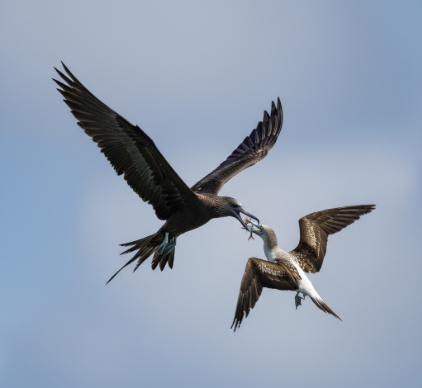
I used to think pirates were the most brazen thieves of the high seas, but then I watched a frigatebird chase down a booby for ten solid minutes.
Frigatebirds—those angular, pterodactyl-looking seabirds with wingspans that can hit seven feet—have basically evolved into the ocean’s aerial muggers. They can’t dive into water because their feathers aren’t waterproof (yeah, seabirds that can’t swim, wrap your head around that), so instead they’ve perfected what ornithologists politely call “kleptoparasitism” but what is really just mid-air robbery. Here’s the thing: they’re absurdly good at it. A frigatebird will spot a booby or tropicbird carrying a hard-won fish, swoop in with those massive wings, and harass the smaller bird—jabbing, dive-bombing, sometimes even grabbing tail feathers—until the victim literally vomits up or drops its catch. Then the frigatebird catches the falling food before it hits the water, because of course it does. The whole operation takes maybe thirty seconds if the frigatebird’s experienced, and honestly the efficiency is both impressive and deeply unsettling.
I’ve seen footage where a frigate will track a booby for miles, just waiting for the right moment. They don’t always attack immediately—they’re calculating, watching for when the other bird is most vulnerable, usually right after a successful dive when it’s tired and its beak is full. Wait—maybe that makes them smart, not just aggressive? Hard to say.
The Anatomical Advantages That Make Frigatebirds Such Effective Aerial Thieves
Turns out their body design is basically built for this lifestyle. Frigatebirds have the lowest wing-loading of any bird—meaning they’ve got huge wings relative to their body weight, roughly 2.3 square meters of wing surface for a bird that weighs maybe 3.3 pounds. This gives them unmatched agility in the air; they can brake, pivot, accelerate in ways that heavier seabirds simply can’t match. Their hooked beaks are perfect for grabbing, and those long forked tails work like rudders for impossibly tight turns.
But there’s a trade-off, and it’s a weird one. Because their feathers lack the oils that most seabirds have, they literally cannot get wet without risking hypothermia or drowning. So while boobies and pelicans are plunge-diving thirty feet down for fish, frigatebirds are stuck skimming the surface or, more often, just stealing from those who can dive. Some researchers think this actually drove the evolution of their kleptoparasitic behavior over maybe 500,000 years, give or take—they couldn’t fish normally anymore, so they became thieves instead. Evolution is messy like that.
Why Victim Birds Don’t Fight Back More Effectively Against These Attacks
You’d think the victim birds would develop better defenses, right?
But here’s where it gets complicated. Most of the species frigatebirds target—red-footed boobies, masked boobies, tropicbirds—are built for diving and swimming, not aerial combat. They’re heavier, their wings are optimized for underwater propulsion, and they’re carrying food in their beaks or throats, which limits maneuverability. A booby trying to outfly a frigatebird is like a delivery truck trying to outrun a motorcycle. The physics just don’t work. Plus, there’s an energy calculation happening: is it worth fighting for five minutes and burning all those calories, or should you just drop the fish and go catch another one? Often the latter makes more sense, which is probably why frigatebirds have such high success rates—researchers have documented success rates above 40% in some colonies, though that number varies wildly depending on location and prey availability.
Some scientists argue this behavior actually stabilizes seabird populations in weird ways, forcing less efficient hunters to improve or relocate, creating pressure that might drive adaptation. Others think it’s just straightforward parasitism that harms victim species, especially in colonies where frigatebirds are common. I guess both could be true? Ecology is rarely simple.
Anyway, the most fascinating part to me is that frigatebirds don’t steal all the time—they do catch their own food too, skimming flying fish off the surface or grabbing squid at night. Studies show kleptoparasitism makes up maybe 5-40% of their diet depending on the season and location. So they’re not completely dependant on theft, but they’re definitely opportunistic about it. On Christmas Island, researchers observed frigatebirds spending entire mornings just loitering near booby colonies, waiting for the fishing shift to return. That’s premeditation. That’s strategy.
Honestly, watching them operate, you start to feel a grudging respect mixed with horror—like witnessing a perfectly executed heist where the victim never stood a chance.