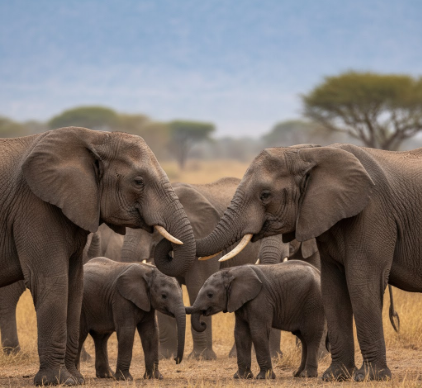
I used to think elephant families were simple—matriarch leads, everyone follows, end of story.
Turns out the social architecture of African elephants is so intricate that researchers are still mapping its contours decades into systematic study. We’re talking about multi-tiered networks that operate simultaneously at the family unit level, the bond group level, the clan level, and what some field biologists now call the “meta-population” level—basically elephants who recognize each other across vast distances and coordinate movements without any obvious communication method we can detect. Joyce Poole, who spent something like forty years documenting elephant behavior in Amboseli, once told an interviewer she’d observed a greeting ceremony between two matriarchs who hadn’t seen each other in roughly four years, and the reunion involved trumpet calls, temporal gland secretions, and what she described as “almost frantic” physical contact that lasted nearly twenty minutes. The emotional intensity wasn’t anthropomorphism—it was biochemically measurable through stress hormone analysis. And here’s the thing: that greeting activated behavioral changes in both family units for days afterward, altering their ranging patterns and foraging decisions in ways that suggested information exchange we still don’t fully understand.
The matriarch system is more complicated than it looks. She’s not just the oldest female—though age matters enormously. She’s the repository of ecological memory.
When Cynthia Moss’s team analyzed decades of demographic data from Amboseli, they found that families led by matriarchs over 55 years old had significantly higher calf survival rates during droughts compared to families with younger leaders. The difference wasn’t subtle—we’re talking about 20-30% better survival odds. Why? Older matriarchs remembered water sources and migration routes from droughts that happened before the younger elephants were even born. They’d learned, probably as calves themselves in the 1960s or 1970s, where to find refuge when the usual waterholes dried up. This isn’t instinct—it’s cultural transmission of survival information across generations. Honestly, it makes you reconsider what we mean by “wisdom” in non-human animals. The matriarch’s knowledge base includes not just geography but social information: which families are allies, which bulls are dangerous, where humans are likely to be hostile. Remove a matriarch through poaching, and you’re not just losing one elephant—you’re erasing a library.
Wait—maybe the most underappreciated aspect is the male social networks, which researchers ignored for years.
Everyone focused on female family groups because they’re cohesive and visible, but bull elephants were dismissed as loners. Recent GPS collar studies have demolished that assumption completely. Adult males maintain complex, long-term friendships with other males, often spending decades in loose association with specific individuals. These aren’t random encounters—they’re deliberate partnerships. Younger males, after leaving their natal families around age 14, apprentice themselves to older bulls in what looks suspiciously like mentorship. The older males teach them everything from musth management (that testosterone-fueled state that makes bulls dangerous and reproductive) to how to read human behavior. In areas with heavy poaching pressure, elephants have learned to avoid humans almost entirely during daylight, and this knowledge spreads through male networks faster than through female family groups, probably because males range more widely. I guess it makes sense—bulls cover territories three or four times larger than female families, so they function as information highways, carrying news about threats, resources, and mating opportunities across landscapes.
The communication systems are frankly exhausting to catalog.
Elephants use infrasound—calls below human hearing range—that can travel up to 10 kilometers through the ground. Other elephants detect these vibrations through their feet and trunks, which are packed with specialized mechanoreceptors. Researchers in Namibia once documented a family group that changed direction in response to an alarm call they recieved from another family more than 8 kilometers away—a family they hadn’t been in physical contact with for months. The acoustic architecture suggests elephants maintain something like a regional communication network, constantly updating each other on conditions across enormous areas. But that’s just one channel. They also use visual signals (ear positions, trunk gestures, body posture), chemical signals (temporal gland secretions, urine, feces), and tactile communication (trunks touching, leaning, pushing). The redundancy seems almost excessive until you realize these animals need to coordinate complex collective decisions—where to go, when to move, whether a threat is serious—across groups that can include 20 or 30 individuals spread over several hundred meters of bush.
The trauma studies changed everything about how we understand elephant society.
Starting in the early 2000s, researchers began noticing aberrant behavior in elephant populations that had experienced severe poaching or culling. Young males were hyper-aggressive, attacking rhinos and even humans unprovoked—behavior essentially unknown in stable populations. Family structures were fractured, with orphaned juveniles forming dysfunctional groups lacking adult guidance. Gay Bradshaw, a psychologist who studied these populations, argued elephants were exhibiting symptoms consistent with PTSD in humans: hypervigilance, social withdrawal, inappropriate aggression, disrupted attachment behaviors. The hypothesis was controversial—some scientists objected to applying human psychiatric frameworks to animals—but the evidence was hard to dismiss. When researchers reintroduced older bulls into populations of traumatized young males in South Africa, the aggression dropped by something like 90% within two years. The presence of elders, it seemed, was therapeutic. It definately suggested that elephant society isn’t just functional—it’s psychologically necessary. Remove too many individuals, especially elders, and you don’t just reduce population numbers. You damage the social fabric in ways that persist for decades, maybe generations.
Anyway, we’re still figuring out what all this means for conservation policy.