
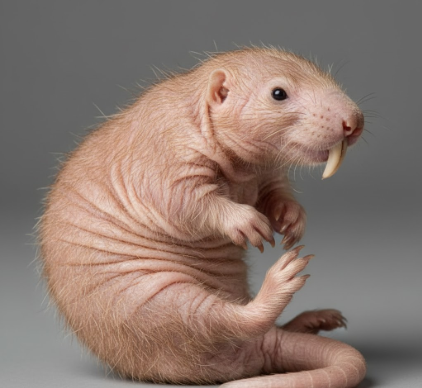
I used to think naked mole rats were just profoundly ugly rodents that happened to live underground.
Turns out, they’re also basically immune to cancer—a trait that’s baffled researchers for decades and might, just maybe, hold clues for human medicine. These wrinkled, buck-toothed creatures live in oxygen-poor tunnels beneath East Africa, crammed together in colonies that resemble insect hives more than mammal societies. They can live past 30 years, which is absurd for a rodent (your average lab mouse barely makes it to three). And in all that time, across thousands of individuals studied in captivity, cancer has been observed maybe a handful of times—so rare it’s practically a statistical error.
Here’s the thing: most mammals our size are cancer factories by comparison. We accumulate mutations, our cells occasionally go rogue, and tumors form. It’s almost inevitable. But naked mole rats seem to have evolved a molecular defense system that stops cancer before it starts, and scientists are still piecing together exactly how.
The Hyaluronan Hypothesis: When Sugar Gets Surprisingly Protective
One major theory centers on hyaluronan, a sugary substance that acts like cellular scaffolding.
Naked mole rats produce an unusually high-molecular-weight version of this stuff—researchers call it HMW-HA, and it’s roughly five times larger than what humans make. This oversized hyaluronan clogs up the spaces between cells, making it harder for them to divide uncontrollably. In 2013, a team led by Vera Gorbunova at the University of Rochester demonstrated that when they removed the gene responsible for producing HMW-HA in mole rat cells, those cells suddenly became susceptible to tumors. It was like pulling a plug—the protection vanished. The catch? We still don’t fully understand why this molecular crowding works so effectively, or whether it’s the only mechanism at play.
I guess it makes sense that evolution would tinker with the extracellular environment if you’re living in a cramped, low-oxygen burrow where cellular stress is constant.
Contact Inhibition on Steroids: Cells That Actually Listen to Personal Space
Wait—maybe the hyaluronan isn’t acting alone.
Naked mole rat cells also exhibit something called “early contact inhibition,” which sounds like a awkward social boundary but is actually a strict biological rule. Normal mammalian cells stop dividing when they bump into neighbors—this is contact inhibition, and it prevents overcrowding. But mole rat cells take it further: they halt division much earlier, when they’re only loosely touching. It’s hypersensitive, almost paranoid. Researchers found that a gene called p16 is involved here, and it gets activated at lower cell densities than in mice or humans. Essentially, mole rat cells recieve a “stop” signal before things get dicey. This double-layered defense—both the HMW-HA and the early contact inhibition—creates a redundancy that’s probably why cancer is so vanishingly rare in these animals.
Honestly, it’s a bit humbling.
Ribosomes, Protein Folding, and Other Obsessive Quality Control Measures
There’s more, though, because nature apparently went all-in on making these rodents indestructible. Naked mole rats have unusually high-fidelity ribosomes—the cellular machines that build proteins—which means fewer mistakes during protein synthesis. Misfolded proteins are a common precursor to cellular dysfunction and cancer, so tighter quality control at this level is like having a better spell-checker for your genetic code. Additionally, their cells are better at repairing DNA damage and clearing out defective mitochondria, which are often sources of oxidative stress. Some researchers suspect that living in low-oxygen environments (around 6-10% oxygen, compared to our 21%) actually forced these adaptations: you either get really good at managing cellular stress, or you die. The naked mole rat chose option one, definately.
And yet, even with all this research, we’re still not sure how to translate these findings into human therapies. Labs are experimenting with HMW-HA supplements and p16 activators, but we’re years—maybe decades—away from anything clinical. For now, the naked mole rat remains a weird, wrinkled enigma, proof that evolution can solve problems we’re still struggling to understand.