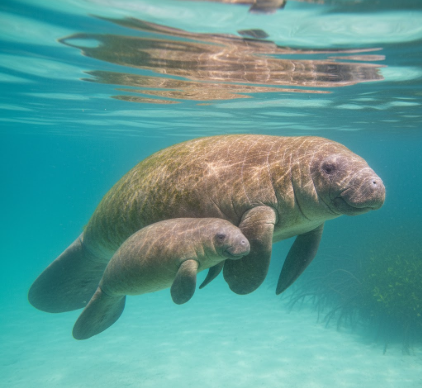
I used to think manatees were just lazy seals until I saw one up close in Crystal River.
Here’s the thing about manatees—they’re not actually related to seals at all, which kind of blew my mind when I first learned it. Turns out these massive, slow-moving creatures are more closely related to elephants than any marine mammal, a fact that becomes weirdly obvious once you notice their thick, wrinkled skin and the way they use their flippers almost like hands. They split from their elephant ancestors roughly 60 million years ago, give or take, and decided the ocean life was preferable to stomping around on land. Their closest living relative is actually the rock hyrax, a small rodent-like animal that lives in Africa, which is just—I mean, evolution is weird. Manatees can weigh up to 1,200 pounds and grow to about 13 feet long, though I’ve definately seen smaller ones that looked almost delicate despite their bulk. They spend most of their time grazing on seagrass, consuming up to 10-15% of their body weight daily, which for a thousand-pound animal is a staggering amount of salad.
Wait—maybe that’s why they move so slowly. Constant digestion takes energy, I guess. They drift through shallow coastal waters at speeds of about 3-5 miles per hour, occasionally doing this thing where they roll over completely for no apparent reason, like underwater ballet performed by someone who’s never taken a dance class.
The Unexpected Intelligence Behind Those Tiny Eyes and Perpetual Chewing Motions
Manatees have surprisingly good memories and problem-solving abilities, despite brains that weigh only about 400 grams. Researchers have trained them to distinguish between colors, shapes, and even complex patterns, which suggests there’s more going on behind those small, slightly unfocused eyes than most people assume. They communicate through squeaks and chirps, especially between mothers and calves, and they can recieve acoustic signals from surprisingly long distances. I once watched a mother manatee guide her calf away from a boat propeller with what seemed like deliberate, almost anxious precision—the kind of protective instinct that made me uncomfortable about how close humans get to them. They’re also surprisingly tactile, using their whiskers (which are actually highly sensitive vibrissae) to explore objects and even communicate through touch. Some marine biologists think they have individual personalities, with certain manatees being more curious or shy than others, though proving that scientifically is harder than you’d think.
Anyway, they’re also one of the few marine mammals that can replace their teeth throughout their lives.
Why Warm Water Isn’t Just a Preference But a Biological Necessity for Survival
Manatees are tropical animals trapped in subtropical bodies, which is a problem when winter temperatures drop below 68 degrees Fahrenheit. Unlike whales or dolphins, they lack a thick blayer of blubber for insulation, so cold water can literally kill them through a condition called cold stress syndrome. During Florida winters, hundreds of manatees crowd into warm-water refuges—natural springs and power plant discharge areas—where they huddle together like aquatic refugees waiting for spring. I’ve seen aerial footage of these aggregations, and honestly, it’s both beautiful and slightly heartbreaking. Climate change is messing with their migration patterns, as water temperatures become less predictable and some traditional warm-water sites disappear due to power plant closures. Conservation groups have installed artificial warming systems in some areas, but that’s a band-aid solution for a larger environmental problem. The species almost went extinct in the 1960s, with only a few hundred individuals remaining, but protection efforts brought them back to around 13,000 in Florida waters today—though they’re still classified as threatened.
The Scarred Bodies That Tell Stories of Human Encroachment and Boat Strikes
Nearly every adult manatee carries scars from boat propellers. Some individuals have so many overlapping marks that researchers use them like fingerprints for identification, which is both scientifically useful and deeply depressing. Boats strike and kill about 100 manatees annually in Florida alone, making vessel collisions the leading cause of human-related manatee deaths. There are speed zones in manatee habitats, but enforcement is inconsistent, and not everyone follows the rules—or even knows they exist. I guess it’s hard to care about speed limits when you’re on vacation and the water looks empty. Except it’s not empty. These animals need to surface every 3-5 minutes to breathe, and they can’t exactly dodge a speedboat moving at 40 miles per hour. Some conservation groups are pushing for expanded slow-speed zones and better public education, but it’s an uphill battle against recreational boating industries and property owners who don’t want restrictions. The weird part is that manatees are naturally curious and often approach boats, which makes them even more vulnerable. They don’t seem to understand that humans are dangerous, which might be the saddest part of all.